 Hindi
Hindi Home
Home Syllabus
 About Us
 Contact Us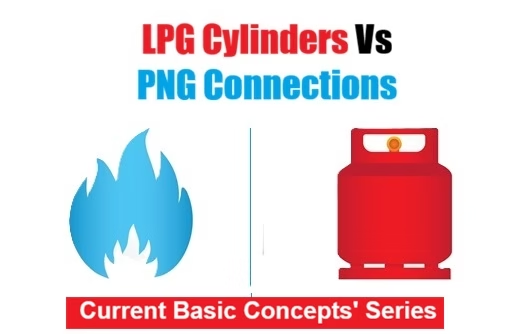

The Indian government has mandated that households with access to Piped Natural Gas (PNG) must switch from LPG cylinders, or face discontinuation of LPG supply.

Why such step?
1. Consumption and production:
- India’s LPG consumption is ~31 million metric tonnes (MMT) annually, of which only ~13 MMT is produced domestically from refineries and natural gas processing in India. About 90% of total demand is consumed by household consumers. So about 60 percent of the LPG demand is imported from the gulf countries notably Saudi Arabia, UAE, and Qatar.
- While PNG consumption is ~7 BCM (billion cubic meters) of which 50 percent is produced domestically mainly from Western Offshore-Arabian Sea (Largest) and Eastern Offshore-Krishna Godavari Basin, Assam, Gujarat, Rajasthan.
- Active LPG domestic connections: ~33 Crore (330 million)
- Active PNG domestic connections: ~1.6 Crore (16 million)
- The government estimates that nearly 60 lakh LPG consumers already live in areas where PNG pipelines exist, making them immediate candidates for migration.
2. Cost:
- LPG involves multiple stages — import, bottling, storage, transport, and delivery — each adding to the final price.
- PNG, once connected through pipelines, eliminates much of this supply chain, making it cheaper for consumers.
- Government provides subsidy for LPG under Pradhan Mantri Ujjwala Yojna to ~10 Crore consumers. Moving urban consumers to PNG reduces long-term fiscal burden.
3. Environment: natural gas burns cleaner than LPG, coal, or biomass, making PNG expansion part of India’s broader plan to reduce urban pollution.

What are the differences between LPG and PNG?
| LPG Vs PNG |
| Liquefied Petroleum Gas (LPG): primarily composed of propane and butane, that is stored and transported in liquid form under pressure. The most commonly used compounds allow users to quickly detect gas leaks include tert-butyl mercaptan, ethyl mercaptan (ethanethiol), or thiophane compounds, which have a pungent, sulfur-like odor similar to rotten eggs. Piped Natural Gas (PNG): primarily methane (CH₄) supplied directly to homes and businesses through pipelines (CGD-City Gas Distribution). |