 Hindi
Hindi Home
Home Syllabus
 About Us
 Contact Us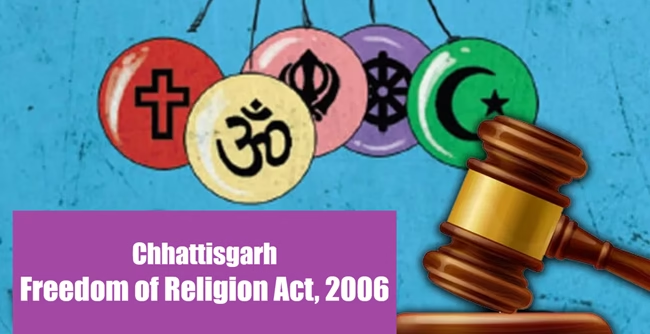
The Chhattisgarh Assembly has approved the draft of Chhattisgarh Freedom of Religion Bill (छत्तीसगढ़ धर्म स्वातंत्र्य विधेयक) 2026 to prohibit the controversial issue of illegal religious conversions. It provides for the strictest punishment of all the anti-conversion laws of the states in India. It has provisions for life imprisonment for mass conversions and up to 20 years in cases involving vulnerable groups such as minors, women, persons with disabilities, and SC/ST/OBC communities. It will replace the 1968 Act.
Prohibition of illegal religious conversion: Section 3
- It prohibits religious conversions carried out through force, inducement, fraud, misrepresentation physically or digitally, or undue influence.
- It prohibits financial assistance from any foreign organization or source for religious conversions.
| Inducements defined under the Act |
| 1. Gifts in the form of cash or kind 2. Monetary or other physical benefits 3. Employment, subsidy, free education and medical facility 4. Marriage promise 5. Better lifestyle 6. Misrepresentation of any religious practice or customs 7. Glorification of a religion against another |
Procedure for religious conversion:
- Declaration (Section 4): If anyone wishes to convert his religion, an application with declaration must be submitted by him and by the concern priest to the competent authority. The competent authority will publish the information on public domain.
- Objections (Section 5): Anyone can file an objection for the religious conversion information published within 30 days.
- Verification/investigation (Section 6): For verification/investigation in the matter, the competent authority will have all the powers, including the power given to police under Sec 46 of Bhartiya Nagrika Suraksha Sanhita (BNSS) 2023 and Sec 5 of Civil Procedure Code 1908.
- Decision by competent authority (Section 7): The competent authority will pass the order/permission within 30 days. Appeal against such orders may be filed to Principal District Judge (Section 8).
- Religious Conversion Certificate (Section 9): The competent authority will issue a Religious Conversion Certificate after receiving declaration from the person within 21 days after the valid religious conversion to authenticate the conversion as per the rules.
- Expiry of the application (Section 11): Such application will be valid for 90 days only and if no conversion takes place, it will be assumed to be concluded.
- Inter-religious marriages (Section 12): Inter-religious marriages are to be informed to the competent authority. Marriages carried out only for religious conversion will be declared invalid.
- Compliance by persons involved (Section 13): persons involved in religious conversion shall maintain the details of the conversions carried out and submit an annual report to the competent authority.
- Return to parent religion (Section 14): if anyone returns to his parent religion, competent authority has to be informed, who will cancel the Religion Conversion Certificate or otherwise issue orders for the same.
| Competent Authority under the Act |
| District Magistrate or any officer not below the rank of Additional District Magistrate (ADM) authorized by him |
Crime and punishment:
- Involvement (Section 15): An individual who assists, advises, carries out or involved in the activities will assume to be against the provisions and will be guilty of the crime.
- Religious conversion (Section 16): 7 to 10 years’ imprisonment and minimum fine of Rs 5 Lakh.
- If crime is against the vulnerable groups (minor, mentally disable, woman, st/sc/obc), 10 to 20 years’ imprisonment and minimum 10 lakh fine.
- For mass religious conversion, 10 years to life imprisonment and 25 Lakh fine.
- It prescribes 10 to 20 years’ imprisonment and minimum 10 lakh fine for a public servant doing the crime.
- It also prescribes life imprisonment for repetition of the offence.
- Attempt to commit a crime (Section 17: punishable with half of the term and fine for commiting the crime.
- Marriage for conversion (Section 18): 6 months to 3 years’ imprisonment and up to 2 Lakh fine.
- Compliance by persons involved (Section 19): 6 months to 3 years’ imprisonment and up to 2 Lakh fine.
- Compensation to the victims (Section 20): up to 10 Lakh by the convicted person
- Cognizable and non-bailable offence (Section 21): offence under this law will be cognizable and non-bailable. Punished under Sections 16, 17 and 18 may get bail only when the Special Public Prosecutor has heard the application for bail.
- Investigation by not below DSP rank officer (Section 22)
- Burden of proof (Section 24): on the person who has carried out such conversion
Special Courts:
- Designation as Special Court (Section 25): for quick resolution Session Court to be designated as Special Court to trial cases under the Act
- Powers and procedure of Special Courts (Section 26): can try even in the absence of convict and as far as possible, complete the hearing within 6 months of final report submission.
- Appointment of special public prosecutor (Section 27): for each Special Court
Further Reading: Development Programs and Laws