 Hindi
Hindi Home
Home Syllabus
 About Us
 Contact Us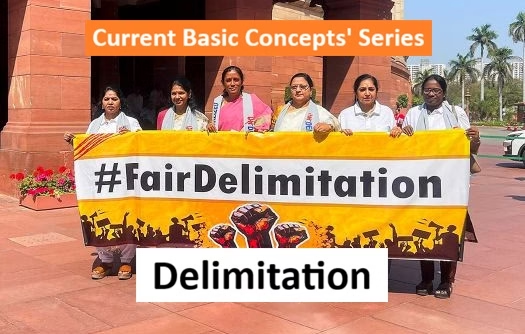

The Constitution (131st Amendment) Bill, 2026, which sought to implement 33% reservation for women in legislatures and expand Lok Sabha seats from 550 to 850, failed in the Lok Sabha on April 17, 2026.

What is Delimitation?
Delimitation refers to the redrawing of boundaries of electoral constituencies for the Lok Sabha and State Legislative Assemblies.
Constitutional Basis
- Article 82: Mandates that after the completion of every Census, the allocation of seats in the Lok Sabha to the states and the division of each state into territorial constituencies shall be readjusted by such authority as Parliament may by law determine.
- Article 170: Provides a similar mandate for the readjustment of constituencies for the State Legislative Assemblies after every Census.
- Article 327: Empowers Parliament to make laws regarding the delimitation of constituencies.
- Article 329(a): States that the validity of any law relating to delimitation or allotment of seats cannot be questioned in any court. This ensures that the election cycle is not delayed by legal disputes over boundaries.
The Delimitation Commission
- It is appointed by the President of India.
- It usually consists of a retired Supreme Court judge (Chairperson), the Chief Election Commissioner, and the respective State Election Commissioners.
- The orders of the Commission have the force of law. They are laid before the Lok Sabha and State Assemblies, but these bodies cannot make any modifications to the Commission’s decisions.

Why Delimitation is carried out?
- Equal Representation: To provide the same degree of representation to the same segment of the population.
- Fair Division: To divide geographical areas into designated seats so that one political party doesn’t have an unfair advantage through boundary manipulation.
- Reservation of Seats: To identify and reserve constituencies for Scheduled Castes (SC) and Scheduled Tribes (ST) based on population proportions as per Articles 330 and 332.

When was Delimitation carried out?
Although the Constitution originally intended for delimitation to happen after every ten-year census, it has been “frozen” twice to allow states time to implement population control measures without losing political representation. There have been 4 Delimitations carried out as per the following:
| No. | Act | Year of Commission | Basis (Census) |
| 1 | Delimitation Commission Act, 1952 | 1952 | 1951 |
| 2 | Delimitation Commission Act, 1962 | 1963 | 1961 |
| 3 | Delimitation Act, 1972 | 1973* | 1971 |
| 4 | Delimitation Act, 2002 | 2002* | 2001 |
* After the 1973 process, the 42nd Amendment froze the number of seats in the Lok Sabha based on the 1971 Census until after the Census 2001 to prevent states with higher population growth from gaining an unfair political advantage over those that implemented population control.
* The 2002 Commission redrew the boundaries of existing seats until after the Census 2026 (to make them roughly equal in population within a state) but was prohibited from increasing the total number of seats. However, due to changes in the demographic proportions of Scheduled Castes (SC) (increased from 79 to 84) and Scheduled Tribes (ST) (increased from 41 to 47), the number of reserved seats had to increase.
Why Delimitation Bill, 2026 failed to pass?
Out of 489 members present, 298 voted in favour and 230 against, falling short of the two-thirds majority required for a constitutional amendment under Article 368 of the Constitution. The major concerns of the opposition are:
1. The North-South Representational Divide:
- The Delimitation Acts froze the number of seats in the Lok Sabha until after the Census 2026 to prevent states with higher population growth from gaining an unfair political advantage over those that implemented population control.
- If seats are redistributed strictly based on current population, Northern states like Uttar Pradesh and Bihar will gain a massive number of seats, while Southern states will see their relative political weight diminish.
- Southern leaders argue they are being “penalized” for their success in social and demographic reforms, leading to a potential crisis in Cooperative Federalism.
2. Increasing seat of the Lok Sabha:
- To mitigate the North-South divide, the government suggested a “pro-rata increase” (roughly 50% across all states) so that every state gains seats and the relative percentage of representation remains stable.
- The Union Government proposed to increase the maximum number of Lok Sabha seats from 550 to 850.
- Opposition argue that even with an increase, the absolute power shift toward the North.
3. Benefit of Women’s Reservation:
- The Nari Shakti Vandan Adhiniyam (2023), which mandates 33% reservation for women, is constitutionally tied to the completion of the next delimitation.
- The government insists that the Lok Sabha must be expanded first so that women’s seats can be added without reducing the number of seats available for men (which could cause internal party revolts).
- The opposition demanded that women’s reservation be implemented immediately within the current 543 seats, rather than waiting for the complex and controversial delimitation process to finish.
Further Current Basic Concepts