 Hindi
Hindi Home
Home Syllabus
 About Us
 Contact Us

The Indian Rupee has recently fallen to a record low breaching 95 per dollar mark during geopolitical tensions due to Iran-Israel War.

Why is Rupee falling?
1. Global Oil Price Surge:
- India imports over 85% of its crude oil needs.
- The ongoing Middle East conflict has pushed oil prices sharply higher, increasing India’s import bill and demand for US dollars.
- This worsens the trade deficit, weakening the rupee.
2. Capital Outflows
- Foreign investors have been pulling money out of Indian markets due to global risk aversion and better returns in the US.
- The US Federal Reserve’s higher interest rates make dollar assets more attractive, reducing inflows into India.
3. Geopolitical Tensions
- The US–Israel–Iran conflict has created uncertainty in global markets.
- Investors prefer the US dollar as a safe haven, further pressuring the rupee.
4. Domestic Economic Factors
- Trade deficit remains high due to expensive imports.
- Dependence on foreign portfolio investors makes the rupee vulnerable to sudden capital flight.
- Inflationary pressures within India add to the weakness.
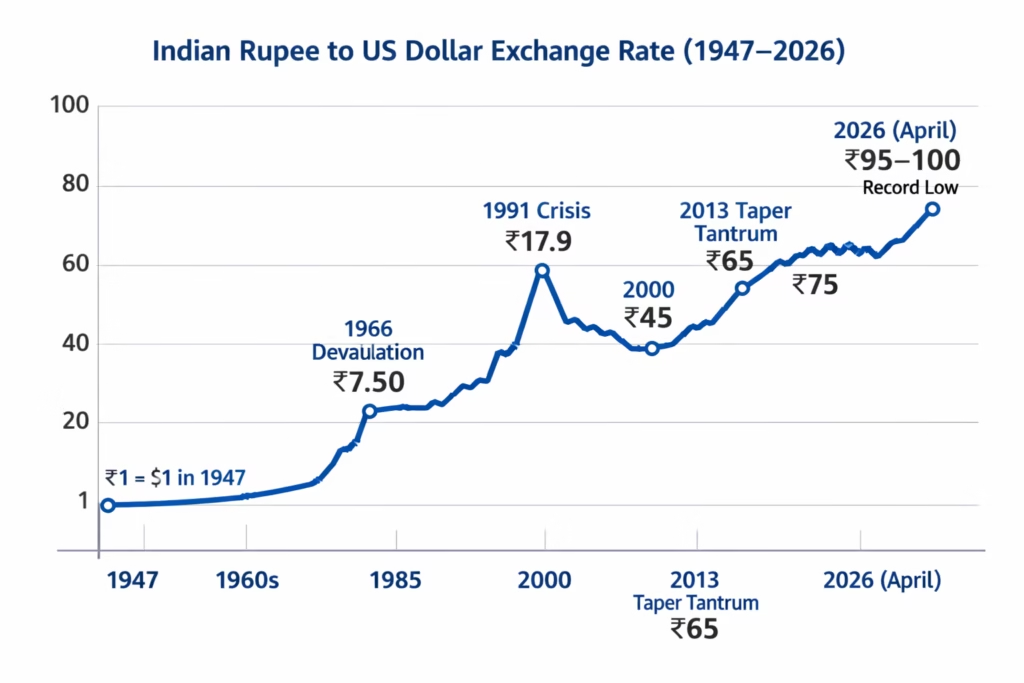
| Devaluation of Rupee |
| Devaluation means a deliberate reduction in the value of a country’s currency relative to foreign currencies, usually by the government or central bank. It is often used to make exports cheaper and imports more expensive, thereby improving trade balance. At the time of independence, the exchange rate was 1 $ = 1 ₹. The Indian Rupee has experienced significant devaluations in its history. • 1949: The first devaluation due to a shortage of foreign exchange and a lack of funds within the government. The value became 1 $ = 3.3 ₹ • 1966: This was driven by multiple factors: severe droughts causing food shortages, high defense expenditures due to the 1962 Sino-Indian War and the 1965 Indo-Pak War, rising inflation, and a significant trade deficit. The value became 1 $ = 7.1 ₹ • 1991: This devaluation was part of broader economic liberalization reforms aimed at stabilizing the economy, addressing foreign exchange shortages, and encouraging exports. The value became 1 $ = 22.72 ₹ |
| Deflation |
| Deflation is a condition in which there is a sustained decrease in the overall price level of goods and services in an economy. Unlike temporary price drops, deflation reflects a generalized downward trend in prices. Causes: • Reduced consumer demand or spending • Excess supply relative to demand • Tight monetary policy or contraction of money supply • Economic recessions leading to unemployment and lower purchasing power |

How are Exchange Rates decided?
Exchange rates are determined by a mix of market forces and policy interventions:
1. Supply & Demand:
- If demand for dollars rises (e.g., due to oil imports), the rupee weakens.
- If foreign investors bring capital into India, demand for rupees rises, strengthening it.
2. Trade Balance
- Trade Deficit (imports > exports): Weakens rupee.
- Trade Surplus (exports > imports): Strengthens rupee.
3. Inflation & Interest Rates
- Higher inflation in India compared to the US reduces rupee’s purchasing power.
- Higher interest rates in India can attract foreign capital, supporting the rupee.
4. Global Events
- Wars, sanctions, or commodity price spikes (like oil) increase dollar demand, weakening the rupee.
5. Central Bank Intervention
- The Reserve Bank of India (RBI) sometimes sells dollars from its reserves to stabilize the rupee.

Who releases the Exchange Rate?
The official exchange rate of the Indian rupee against the US dollar is released by the Reserve Bank of India (RBI) every working day. The actual exchange rate you get depends on banks and market forces.
• RBI calculates the rate based on trading activity in the interbank forex market.
• It takes the weighted average of actual transactions during a specific time window.
• This ensures the rate reflects real market conditions, not just speculation.
Role of RBI to stabilize Rupee
1. Direct Intervention in Forex Market
• RBI sells US dollars from its reserves to increase dollar supply and reduce pressure on the rupee.
• This is the most immediate tool, but it depletes reserves if used excessively.
2. Interest Rate Adjustments
• Raising interest rates (Repo Rate) makes Indian assets more attractive to foreign investors, increasing capital inflows.
• However, higher rates can slow domestic growth, so RBI uses this cautiously.
3. Liquidity Management
• RBI can tighten liquidity in the banking system, making speculation against the rupee costlier.
• This discourages traders from betting on further depreciation.
4. Capital Flow Measures
• Encouraging foreign investment inflows (FDI, FPI) by easing rules or offering incentives.
• Sometimes, temporary restrictions on outward remittances or speculative trading are imposed.
5. Macroprudential Policies
• Coordinating with the government to reduce the trade deficit (e.g., curbing gold imports, promoting exports).
• Fiscal measures like subsidies or tax incentives for exporters can help balance external accounts.
| Effects of RBI’s stabilization measures on everyday life |
| 1. Forex Intervention (Selling Dollars) • Keeps the rupee from sliding too fast, which helps control import prices (oil, electronics). • Without intervention, petrol, diesel, and gadgets would become even more expensive. 2. Interest Rate (Repo Rate) Hikes • Loans & EMIs: Home loans, car loans, and personal loans become costlier. • Savings: Bank deposits earn higher interest, which benefits savers. • Jobs: Higher borrowing costs can slow business expansion, affecting hiring. 3. Liquidity Tightening • Businesses find it harder to borrow cheaply, which can slow growth. • Inflation control helps households by preventing runaway price increases. 4. Encouraging Capital Inflows • More foreign investment can boost industries like IT, manufacturing, and startups. • This creates jobs and stabilizes the rupee in the medium term. 5. Trade & Fiscal Measures • Export-driven sectors (textiles, IT services) may see growth and job creation. • Import restrictions (like on gold) can affect consumer choices and prices. |