 Hindi
Hindi Home
Home Syllabus
 About Us
 Contact Us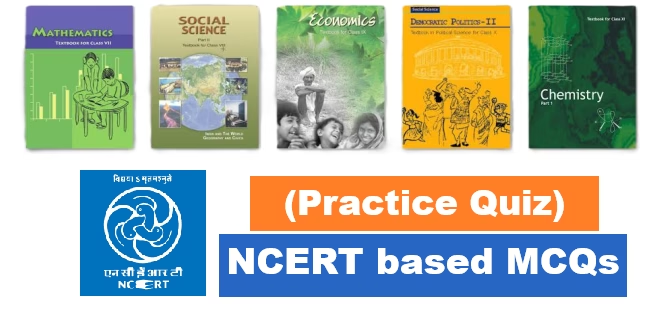
Conceptual understanding of all the topics is the most important part of preparation for an examination. CBSE Curriculum based Objective Questions from Class-VI to XII provide an excellent option to test your basic concepts.
The following Quiz consists of questions from NCERT Class IX Civics. Aspirants may practice these questions to have a revision of the fundamental concepts of the subject.
Quiz-summary
0 of 38 questions completed
Questions:
- 1
- 2
- 3
- 4
- 5
- 6
- 7
- 8
- 9
- 10
- 11
- 12
- 13
- 14
- 15
- 16
- 17
- 18
- 19
- 20
- 21
- 22
- 23
- 24
- 25
- 26
- 27
- 28
- 29
- 30
- 31
- 32
- 33
- 34
- 35
- 36
- 37
- 38
Information
Please fill your name and email id to start the Quiz.
You have already completed the quiz before. Hence you can not start it again.
Quiz is loading...
You must sign in or sign up to start the quiz.
You have to finish following quiz, to start this quiz:
Results
0 of 38 questions answered correctly
Your time:
Time has elapsed
You have reached 0 of 0 points, (0)
Categories
- Not categorized 0%
- NCERT 0%
Well done! Keep practicing.
To see yourself in the leader board, click on ‘Send’ then ‘Show leaderboard’.
| Pos. | Name | Entered on | Points | Result |
|---|---|---|---|---|
| Table is loading | ||||
| No data available | ||||
- 1
- 2
- 3
- 4
- 5
- 6
- 7
- 8
- 9
- 10
- 11
- 12
- 13
- 14
- 15
- 16
- 17
- 18
- 19
- 20
- 21
- 22
- 23
- 24
- 25
- 26
- 27
- 28
- 29
- 30
- 31
- 32
- 33
- 34
- 35
- 36
- 37
- 38
- Answered
- Review
- Question 1 of 38
1. Question
Category: NCERTThe United Nations is a global association of nations of the world to help cooperation in international law, security, economic development and social equity. With reference to the above sentence, consider the following statements:
1. The UN Security Council can put together an international army and take action against the wrongdoer.
2. The UN General Assembly cannot take any decision about what action should be taken in a conflict between different countries.CorrectThe UN Security Council, an organ of the UN, is responsible for maintaining peace and security among countries. It can put together an international army and take action against the wrongdoer.
But the General Assembly cannot take any decision about what action should be taken in a conflict between different countries.
IncorrectThe UN Security Council, an organ of the UN, is responsible for maintaining peace and security among countries. It can put together an international army and take action against the wrongdoer.
But the General Assembly cannot take any decision about what action should be taken in a conflict between different countries.
- Question 2 of 38
2. Question
Category: NCERTWhich of the following sentences is incorrect about the International Monetary Fund?
1. The member states have equal voting rights.
2. The Global Financial Stability Report is released by it.CorrectThe vote of each country is weighed by how much money it has contributed to the IMF. Nearly half of the voting power in the IMF is in the hands of only seven countries (US, Japan, France, UK, Saudi Arabia, China and Russia).
The Global Financial Stability Report provides an assessment of the global financial system and markets, and addresses emerging market financing in a global context.
IncorrectThe vote of each country is weighed by how much money it has contributed to the IMF. Nearly half of the voting power in the IMF is in the hands of only seven countries (US, Japan, France, UK, Saudi Arabia, China and Russia).
The Global Financial Stability Report provides an assessment of the global financial system and markets, and addresses emerging market financing in a global context.
- Question 3 of 38
3. Question
Category: NCERTConsider the following statements regarding Iraq’s invasion:
1. The US alleged that Iraq possessed secret nuclear weapons and other ‘weapons of mass destruction’.
2. The war against Iraq was authorised by the UN Security Council.CorrectThe US and its allies like Britain, alleged that Iraq possessed secret nuclear weapons and other ‘weapons of mass destruction’ which posed a big threat to the world. But when a UN team went to Iraq to search for such weapons, it did not find any. Still the US and its allies invaded Iraq, occupied it and removed Saddam Hussein from power.
The war against Iraq was not authorised by the UN Security Council. Kofi Annan, the UN Secretary General, said that the US war on Iraq was illegal.
IncorrectThe US and its allies like Britain, alleged that Iraq possessed secret nuclear weapons and other ‘weapons of mass destruction’ which posed a big threat to the world. But when a UN team went to Iraq to search for such weapons, it did not find any. Still the US and its allies invaded Iraq, occupied it and removed Saddam Hussein from power.
The war against Iraq was not authorised by the UN Security Council. Kofi Annan, the UN Secretary General, said that the US war on Iraq was illegal.
- Question 4 of 38
4. Question
Category: NCERTWhich of the following statement(s) is/are true about today’s world?
1. International Organizations, like the UN, are becoming less democratic.
2. In recent times, the United States of America has taken on the task of democracy promotion in the rest of the world.CorrectBoth 1 and 2
Incorrect - Question 5 of 38
5. Question
Category: NCERTDemocracy is a form of government in which the rulers are elected by the people. With reference to democracy, consider the following statements:
1. All major decisions are taken by the elected rulers.
2. The choice and opportunity to change the ruler is available to all the people on an equal basis.
3. A democratic government rules within limits set by constitutional law and citizens’ rights.
4. Each vote in a democracy must have one value.CorrectAll of the above
IncorrectAll of the above
- Question 6 of 38
6. Question
Category: NCERTDemocratic form of government may not be the ideal form of government. Which of the above given statements is/are the correct arguments to support the above sentence?
1. Consulting so many people in a democracy leads to delays in policy implementation.
2. As the elected leaders do not know the best interest of the people, it might lead to bad decisions.CorrectArguments against Democracy:
- Leaders keep changing in a democracy. This leads to instability.
- Democracy is all about political competition and power play. There is no scope for morality.
- So many people have to be consulted in a democracy that it leads to delays.
- Elected leaders do not know the best interest of the people. It leads to bad decisions.
- Democracy leads to corruption for it is based on electoral competition.
- Ordinary people don’t know what is good for them; they should not decide anything.
IncorrectArguments against Democracy:
- Leaders keep changing in a democracy. This leads to instability.
- Democracy is all about political competition and power play. There is no scope for morality.
- So many people have to be consulted in a democracy that it leads to delays.
- Elected leaders do not know the best interest of the people. It leads to bad decisions.
- Democracy leads to corruption for it is based on electoral competition.
- Ordinary people don’t know what is good for them; they should not decide anything.
- Question 7 of 38
7. Question
Category: NCERTWhich of the following sentence(s) is/are incorrect?
1. Due to the involvement of a large number of people, the quality of decisions in a democracy improves.
2. A democratic setup guarantees no mistakes, due to the involvement of many people.CorrectThere is no guarantee that mistakes cannot be made in democracy.
IncorrectThere is no guarantee that mistakes cannot be made in democracy.
- Question 8 of 38
8. Question
Category: NCERTThe most common form that democracy takes in our times is that of a representative democracy. With reference to the above sentence, consider the following statements:
1. It is also called as Indirect democracy.
2. In a representative democracy, a minority is allowed to take decisions on behalf of all the people.
3. India is an example of representative democracy.CorrectRepresentative democracy is also called as Indirect democracy.
IncorrectRepresentative democracy is also called as Indirect democracy.
- Question 9 of 38
9. Question
Category: NCERTConsider the following statements about features of democracy in India:
1. It provides for collective responsibility of the representatives.
2. Indian democracy depends on the popular sovereignty of the government.CorrectBoth 1 and 2
IncorrectBoth 1 and 2
- Question 10 of 38
10. Question
Category: NCERTThe constitution of a country is a set of written rules that are accepted by all people living together in a country. Consider the following statements about a Constitution:
1. It is the supreme law that determines the relationship among people living in a territory.
2. The Constitution decides who will have power to take which decisions.
3. All countries that are democratic don’t necessarily have constitutions.CorrectAll countries that have constitutions are not necessarily democratic. But all countries that are democratic will have constitutions.
IncorrectAll countries that have constitutions are not necessarily democratic. But all countries that are democratic will have constitutions.
- Question 11 of 38
11. Question
Category: NCERTArrange the following in the order of their appearance in the Preamble to the Indian Constitution:
1. Faith and worship
2. Dignity of the individual
3. Justice
4. EqualityCorrectPreamble to the Indian Constitution:
WE, THE PEOPLE OF INDIA, having solemnly resolved to constitute India into a SOVEREIGN SOCIALIST
SECULAR DEMOCRATIC REPUBLIC and to secure to all its citizens:
JUSTICE, social, economic and political;
LIBERTY of thought, expression, belief, faith and worship;
EQUALITY of status and of opportunity; and to promote among them all
FRATERNITY assuring the dignity of the individual and the unity and integrity of the Nation;
In Our Constituent Assembly this twenty-sixth day of November, 1949, do Hereby Adopt, Enact And Give To Ourselves This Constitution.
IncorrectPreamble to the Indian Constitution:
WE, THE PEOPLE OF INDIA, having solemnly resolved to constitute India into a SOVEREIGN SOCIALIST
SECULAR DEMOCRATIC REPUBLIC and to secure to all its citizens:
JUSTICE, social, economic and political;
LIBERTY of thought, expression, belief, faith and worship;
EQUALITY of status and of opportunity; and to promote among them all
FRATERNITY assuring the dignity of the individual and the unity and integrity of the Nation;
In Our Constituent Assembly this twenty-sixth day of November, 1949, do Hereby Adopt, Enact And Give To Ourselves This Constitution.
- Question 12 of 38
12. Question
Category: NCERTConsider the following statements regarding nomination of candidates for elections:
1. The person wishing to contest an election has to provide ‘security money’ which shall never be forfeited.
2. Constitution provides for the education qualifications of the candidate wishing to contest an election.CorrectNone of the above
IncorrectNone of the above
- Question 13 of 38
13. Question
Category: NCERTNowadays electronic voting machines (EVM) are used to record votes. With reference to the above sentence, consider the following statements:
1. EVMs have been used in all general and state assembly elections of India since 2004.
2. The machine shows the names of the candidates, names of parties and the party symbols.Select the correct answer using the code given below:
CorrectThe use of EVMs and electronic voting was developed and tested by the state-owned Electronics Corporation of India and Bharat Electronics in the 1990s. They were introduced in Indian elections between 1998 and 2001, in a phased manner. The electronic voting machines have been used in all general and state assembly elections of India since 2004.
The machine shows the names of the candidates and the party symbols.
IncorrectThe use of EVMs and electronic voting was developed and tested by the state-owned Electronics Corporation of India and Bharat Electronics in the 1990s. They were introduced in Indian elections between 1998 and 2001, in a phased manner. The electronic voting machines have been used in all general and state assembly elections of India since 2004.
The machine shows the names of the candidates and the party symbols.
- Question 14 of 38
14. Question
Category: NCERTIn India elections are conducted by an independent and very powerful Election Commission (EC). Consider the following statements about the EC:
1. It enjoys the same kind of independence that the judiciary enjoys.
2. The Chief Election Commissioner is answerable to the government.
3. When on election duty, government officers work under the control of the EC and not the government.Select the correct answers using the code given below:
CorrectThe Chief Election Commissioner (CEC) is appointed by the President of India. But once appointed, the Chief Election Commissioner is not answerable to the President or the government.
IncorrectThe Chief Election Commissioner (CEC) is appointed by the President of India. But once appointed, the Chief Election Commissioner is not answerable to the President or the government.
- Question 15 of 38
15. Question
Category: NCERTThe Government of India had appointed the Second Backward Classes Commission in 1979, popularly known as the Mandal Commission. With reference to this commission, consider the following statements:
1. It was asked to determine the criteria to identify the socially backward castes, tribes and classes in India.
2. Its recommendations were implemented under the Prime Ministership of V.P. Singh.
3. The benefits of job reservation were then made available to Scheduled Castes, Scheduled Tribes and Other Backward Classes.Select the incorrect answer(s) from the code given below:
CorrectOn 6 August 1990, the Union Cabinet took a formal decision to implement the recommendations of the Mandal Commission. Other statements are incorrect as reservation to ST and SC was already available.
IncorrectOn 6 August 1990, the Union Cabinet took a formal decision to implement the recommendations of the Mandal Commission. Other statements are incorrect as reservation to ST and SC was already available.
- Question 16 of 38
16. Question
Category: NCERTConsider the following statements regarding the composition of the Indian Parliament:
1. The President, though part of the executive, is not a part of the Parliament.
2. The joint session is called to end the deadlock between the two houses, on ordinary bills only.Select the correct answer(s) from the code given below:
CorrectThe President of India is a part of the Parliament, although is not a member of either House. That is why all laws made in the Houses come into force only after they receive the assent of the President.
Joint Session of the Parliament also applies for financial bills.
IncorrectThe President of India is a part of the Parliament, although is not a member of either House. That is why all laws made in the Houses come into force only after they receive the assent of the President.
Joint Session of the Parliament also applies for financial bills.
- Question 17 of 38
17. Question
Category: NCERTConsider the following statements regarding the powers of the head of the government:
1. The Constitution clearly mentions in detail about the powers of the head of the government or the ministers or their relationship with each other.
2. He distributes and redistributes work to the ministers.Select the correct answer(s) from the code given below:
CorrectThe Constitution does not say very much about the powers of the PM/CM or the ministers or their relationship with each other.
The PM/CM distributes and redistributes work to the ministers. He also has the power to dismiss ministers. When the quits, the entire ministry quits.
IncorrectThe Constitution does not say very much about the powers of the PM/CM or the ministers or their relationship with each other.
The PM/CM distributes and redistributes work to the ministers. He also has the power to dismiss ministers. When the quits, the entire ministry quits.
- Question 18 of 38
18. Question
Category: NCERTConsider the following statements regarding the Head of the State in India:
1. He supervises the overall functioning of all the political institutions in the country.
2. He is indirectly elected.Select the correct answer(s) from the code given below:
CorrectWhile the Prime Minister is the head of the government, the President is the head of the State.
IncorrectWhile the Prime Minister is the head of the government, the President is the head of the State.
- Question 19 of 38
19. Question
Category: NCERTIn many countries of the world, the President is both the head of the state and the head of the government. Consider the following statements:
1. The President of the USA is an example, who appoints all ministers.
2. He is answerable to the Congress of his country.Select the correct answer(s) from the code given below:
CorrectThe President of the United States is not directly answerable to Congress in the day-to-day execution of duties, but Congress holds significant oversight powers, including impeachment authority, budgetary control, and legislative checks.
He has a fixed tenure of four years and completes it even if his party does not have a majority in the Congress.
IncorrectThe President of the United States is not directly answerable to Congress in the day-to-day execution of duties, but Congress holds significant oversight powers, including impeachment authority, budgetary control, and legislative checks.
He has a fixed tenure of four years and completes it even if his party does not have a majority in the Congress.
- Question 20 of 38
20. Question
Category: NCERTWhich of the following statements regarding the Indian Judiciary is correct?
1. The Chief Justice of India is appointed by the President in consultation with the Prime Minister.
2. The Supreme Court alone has been given the power to interpret the Constitution.
3. A judge can be removed only by a motion passed separately by two-thirds members of the two Houses of the Parliament.CorrectThe senior most judge of the Supreme Court is usually appointed the Chief Justice of India by the President.
The Supreme Court and the High Courts have the power to interpret the Constitution of the country.
IncorrectThe senior most judge of the Supreme Court is usually appointed the Chief Justice of India by the President.
The Supreme Court and the High Courts have the power to interpret the Constitution of the country.
- Question 21 of 38
21. Question
Category: NCERTConsider the following statements regarding freedom of speech and expression:
1. One is free to criticise the government and incite people to rebel against the government.
2. Grounds of defamation is one of the reasonable restrictions that can be imposed by the State.Which of the above given statement(s) are correct?
CorrectNeither can one use it to defame others by saying false and mean things that cause damage to a person’s reputation.
IncorrectNeither can one use it to defame others by saying false and mean things that cause damage to a person’s reputation.
- Question 22 of 38
22. Question
Category: NCERTWhich of the following sentences regarding right to freedom is correct?
1. The Constitution says that no person can be deprived of his life or personal liberty under any circumstances.
2. A person who is arrested and detained shall be produced before the nearest magistrate within a period of 24 hours of arrest.CorrectThe Constitution says that no person can be deprived of his life or personal liberty except according to procedure established by law.
IncorrectThe Constitution says that no person can be deprived of his life or personal liberty except according to procedure established by law.
- Question 23 of 38
23. Question
Category: NCERTArrange the following in the correct order as written in Article 19(1), Part III of the Indian Constitution:
1. Freedom of Association
2. Freedom of Residence
3. Freedom of Movement
4. Freedom of ProfessionCorrectArticle 19 (1):
a) Freedom of speech and expression.
b) Freedom to assemble peacefully and without arms.
c) Freedom to form associations or unions.
d) Freedom to move freely throughout the territory of India.
e) Freedom to reside and settle in any part of the territory of India.
f) Freedom to practise any profession, or to carry on any occupation, trade, or business.IncorrectArticle 19 (1):
a) Freedom of speech and expression.
b) Freedom to assemble peacefully and without arms.
c) Freedom to form associations or unions.
d) Freedom to move freely throughout the territory of India.
e) Freedom to reside and settle in any part of the territory of India.
f) Freedom to practise any profession, or to carry on any occupation, trade, or business. - Question 24 of 38
24. Question
Category: NCERTConsider the following statements regarding Right to Freedom of Religion:
1. Right to convert under this freedom is a fundamental right.
2. Taxes collected can be used for the promotion of all religions.Which of the given statement(s) is/are correct?
CorrectA right to propagate one’s religion, however, does not mean that a person has the right to compel another person to convert into his religion by means of force, fraud, inducement or allurement. Of course, a person is free to change religion on his or her own will.
The government cannot compel any person to pay any taxes for the promotion or maintenance of any particular religion or religious institution. However, it can use the collected taxes for the promotion and maintenance of all religions.
IncorrectA right to propagate one’s religion, however, does not mean that a person has the right to compel another person to convert into his religion by means of force, fraud, inducement or allurement. Of course, a person is free to change religion on his or her own will.
The government cannot compel any person to pay any taxes for the promotion or maintenance of any particular religion or religious institution. However, it can use the collected taxes for the promotion and maintenance of all religions.
- Question 25 of 38
25. Question
Category: NCERTWhich of the following statements regarding the Cultural and Educational Rights is correct?
1. All minorities have been given the right to establish educational institutions of their choice.
2. It has been provided to only religious and linguistic minorities.CorrectCultural and educational rights in India are not limited solely to religious and linguistic minorities; while Article 30 specifically protects minorities, Article 29 extends protection to any section of citizens with a distinct language, script, or culture, regardless of minority status.
IncorrectCultural and educational rights in India are not limited solely to religious and linguistic minorities; while Article 30 specifically protects minorities, Article 29 extends protection to any section of citizens with a distinct language, script, or culture, regardless of minority status.
- Question 26 of 38
26. Question
Category: NCERTConsider the following statements regarding Right to Constitutional Remedies mentioned in the Indian Constitution:
1. Fundamental Rights are guaranteed against the actions of the Legislatures only.
2. Any citizen can approach the Supreme Court or a High Court for the protection of public interest against a particular law or action of the government.CorrectFundamental Rights are guaranteed against the actions of the Legislatures, the Executive, and any other authorities instituted by the government. There can be no law or action that violates the Fundamental Rights.
IncorrectFundamental Rights are guaranteed against the actions of the Legislatures, the Executive, and any other authorities instituted by the government. There can be no law or action that violates the Fundamental Rights.
- Question 27 of 38
27. Question
Category: NCERTWhich of the following statements regarding Right against Exploitation is correct?
1. Begar is a practice where the worker is forced to render service to the ‘master’ free of charge.
2. Child labour is not prohibited in harmless work.CorrectWork in non-hazardous sectors, such as light household chores or helping in family businesses (after school hours), is generally outside Article 24’s prohibition
IncorrectWork in non-hazardous sectors, such as light household chores or helping in family businesses (after school hours), is generally outside Article 24’s prohibition
- Question 28 of 38
28. Question
Category: NCERTWith reference to the United Nations Security Council (UNSC), Consider the following statements;
1. UNSC is responsible for maintaining peace and security among countries.
2. There are five permanent members and fifteen non-permanent members in UNSC.
3. Non-permanent members are elected by the General Assembly for four-year terms.
Which of the above statement is/are incorrect?CorrectThe UN Security Council has 10 non-permanent members elected for two-year terms, representing different regional groups.
IncorrectThe UN Security Council has 10 non-permanent members elected for two-year terms, representing different regional groups.
- Question 29 of 38
29. Question
Category: NCERTRegarding World Bank, which of the following statement is incorrect?
1. Members states do not have equal voting rights.
2. President of World Bank is elected by the Member countries.
Choose the correct answer using the code given below.CorrectWorld Bank member states do not have equal voting rights. The vote of each country is weighed by how much money it has contributed.
The President of the World Bank has always been a citizen of the US, conventionally nominated by the Treasury Secretary (Finance Minister) of the US government.IncorrectWorld Bank member states do not have equal voting rights. The vote of each country is weighed by how much money it has contributed.
The President of the World Bank has always been a citizen of the US, conventionally nominated by the Treasury Secretary (Finance Minister) of the US government. - Question 30 of 38
30. Question
Category: NCERTwhy is democracy considered the best form of government?
1. It provides a method to deal with differences and conflicts.
2. Democratic government is more accountable form of government.
3. As it elected by the People there is no scope for the mistakes.
Choose the correct code from the following;CorrectThere is no guarantee that mistakes cannot be made in democracy. No form of government can guarantee that. The advantage in a democracy is that such mistakes cannot be hidden for long.
IncorrectThere is no guarantee that mistakes cannot be made in democracy. No form of government can guarantee that. The advantage in a democracy is that such mistakes cannot be hidden for long.
- Question 31 of 38
31. Question
Category: NCERTMatch the following leaders with their roles in the making of the Constitution:
1. Motilal Nehru A. President of the Constituent Assembly
2. B.R. Ambedkar B. Member of the Constituent Assembly
3. Rajendra Prasad C. Chairman of the Drafting Committee
4. Sarojini Naidu D. Prepared a Constitution for India in 1928
Choose the correct code from the following;CorrectIn 1928, Motilal Nehru and eight other Congress leaders drafted a constitution for India.
Sarojini Naidu was the member of the Constitution Assembly. Among nine women members she was the one.IncorrectIn 1928, Motilal Nehru and eight other Congress leaders drafted a constitution for India.
Sarojini Naidu was the member of the Constitution Assembly. Among nine women members she was the one. - Question 32 of 38
32. Question
Category: NCERTConsider the following statement about path towards making Constitution:
1. In 1928, Jawaharlal Nehru and other Congress leaders drafted a constitution for India.
2. At Karachi session in 1931, a resolution passed by Indian National Congress leader which dwelt on values of independent India constitution.
3. Both these documents were committed to inclusion of universal adult franchise, right to freedom and equality.Which of the above statement is/are correct?
CorrectIn 1928, Jawaharlal Nehru and other Congress leaders prepared a draft constitution for India. In 1931, at the Karachi session, the Congress passed a resolution that laid down the values of the future Constitution of independent India.
Both these documents were committed to the inclusion of universal adult franchise, right to freedom and equality and to protecting the rights of minorities in the constitution of independent India.
IncorrectIn 1928, Jawaharlal Nehru and other Congress leaders prepared a draft constitution for India. In 1931, at the Karachi session, the Congress passed a resolution that laid down the values of the future Constitution of independent India.
Both these documents were committed to the inclusion of universal adult franchise, right to freedom and equality and to protecting the rights of minorities in the constitution of independent India.
- Question 33 of 38
33. Question
Category: NCERTWhich of the following pair is incorrectly matched?
Keyword in Constitution Meaning
- Sovereign – People have supreme right to make Decisions on internal as well as external matters.
- Democratic – A form of government where people enjoy Equal political rights, elect their rulers and hold them accountable.
- Liberty – Complete freedom to the citizens in what they think, how they wish to express their thoughts.
- Republic – The head of the state is an elected person and not a hereditary position.
Choose the correct code from the below;
CorrectLiberty: There may be reasonable restrictions on the citizens in what they think, how they wish to express their thoughts.
IncorrectLiberty: There may be reasonable restrictions on the citizens in what they think, how they wish to express their thoughts.
- Question 34 of 38
34. Question
Category: NCERTWhat are the characteristics of democratic elections?
- Everyone should have right to vote and every vote must have equal value.
- Candidates should free to contest the election.
- Elections should be held regularly.
- The candidate preferred by the party should get elected.
Choose the correct code from the following;
CorrectIncorrect - Question 35 of 38
35. Question
Category: NCERTRegarding powers of Election Commission (EC), Consider the following statements;
- EC implement the code of conduct and order judiciary to punish the candidate or party if they violate it.
- During the election period, the EC can order the government to follow certain guidelines.
- On election duty, government officers work under the control of the EC and not the government.
Which of the above statement is/are incorrect?
CorrectECI implements the Code of Conduct and punishes any candidate or party that violates it.
IncorrectECI implements the Code of Conduct and punishes any candidate or party that violates it.
- Question 36 of 38
36. Question
Category: NCERTWhich of the following statements regarding Indian Parliament is correct?
- It is the final authority for making laws in country.
- Its control over the government is direct and full.
- It controls all the money.
Choose the correct code from the following:
CorrectIncorrect - Question 37 of 38
37. Question
Category: NCERTWhich of the following rights recognized by international covenant but cannot directly a part of the Fundamental Rights in the Indian Constitution.
1. Right to safe and healthy working conditions.
2. Right to adequate standard of living.
3. Right to health.
Choose the correct code from the below:CorrectIncorrect - Question 38 of 38
38. Question
Category: NCERTConsider the following statements about human rights commission:
1. It is a statutory Commission which was setup in 1991.
2. The Commission is independent of the government.
3. The Commission is appointed by the chief Justice of India.
Which of the above statement is /are correct?CorrectLike judiciary, the Commission is independent of the government.
The Commission is appointed by the President and includes retired judges, officers and eminent citizens.
IncorrectLike judiciary, the Commission is independent of the government.
The Commission is appointed by the President and includes retired judges, officers and eminent citizens.
NCERT Based Quiz