 Hindi
Hindi Home
Home Syllabus
 About Us
 Contact Us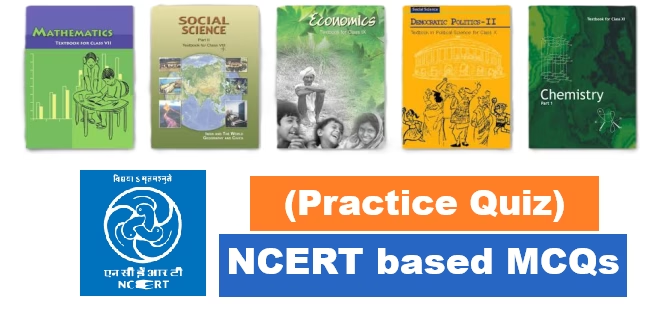
Conceptual understanding of all the topics is the most important part of preparation for an examination. CBSE Curriculum based Objective Questions from Class-VI to XII provide an excellent option to test your basic concepts.
The following Quiz consists of questions from NCERT Class X Civics. Aspirants may practice these questions to have a revision of the fundamental concepts of the subject.
Quiz-summary
0 of 39 questions completed
Questions:
- 1
- 2
- 3
- 4
- 5
- 6
- 7
- 8
- 9
- 10
- 11
- 12
- 13
- 14
- 15
- 16
- 17
- 18
- 19
- 20
- 21
- 22
- 23
- 24
- 25
- 26
- 27
- 28
- 29
- 30
- 31
- 32
- 33
- 34
- 35
- 36
- 37
- 38
- 39
Information
Please fill your name and email id to start the Quiz.
You must specify a text. | |
You must specify an email address. |
You have already completed the quiz before. Hence you can not start it again.
Quiz is loading...
You must sign in or sign up to start the quiz.
You have to finish following quiz, to start this quiz:
Results
0 of 39 questions answered correctly
Your time:
Time has elapsed
You have reached 0 of 0 points, (0)
Categories
- NCERT 0%
Well done! Keep practicing.
To see yourself in the leader board, click on ‘Send’ then ‘Show leaderboard’.
| Pos. | Name | Entered on | Points | Result |
|---|---|---|---|---|
| Table is loading | ||||
| No data available | ||||
- 1
- 2
- 3
- 4
- 5
- 6
- 7
- 8
- 9
- 10
- 11
- 12
- 13
- 14
- 15
- 16
- 17
- 18
- 19
- 20
- 21
- 22
- 23
- 24
- 25
- 26
- 27
- 28
- 29
- 30
- 31
- 32
- 33
- 34
- 35
- 36
- 37
- 38
- 39
- Answered
- Review
- Question 1 of 39
1. Question
Category: NCERTWhat are the benefits of horizontal power sharing of power within different organs of the government?
1. It ensures that none of the organs can exercise unlimited power.
2. It creates balance of power among various institutions.
3. It ensures check and balance system among different organs of government.
Choose the correct code from the following:CorrectPower is shared among different organs of government, such as the legislature, executive and judiciary. Let us call this horizontal distribution of power because it allows different organs of government placed at the same level to exercise different powers.
IncorrectPower is shared among different organs of government, such as the legislature, executive and judiciary. Let us call this horizontal distribution of power because it allows different organs of government placed at the same level to exercise different powers.
- Question 2 of 39
2. Question
Category: NCERTConsider the following statements regarding ‘different levels of government’:
1. Our Constitution clearly lays down the powers of different levels of government.
2. Power sharing between different levels of government are called as vertical division of power.
Which of the above statements is/are correct?CorrectDivision of powers involving higher and lower levels of government is called vertical division of power.
IncorrectDivision of powers involving higher and lower levels of government is called vertical division of power.
- Question 3 of 39
3. Question
Category: NCERTSystem of ‘checks and balances’ means:
CorrectPower is shared among different organs of government, such as the legislature, executive and judiciary. Separation ensures that none of the organs can exercise unlimited power. Each organ checks the others.
IncorrectPower is shared among different organs of government, such as the legislature, executive and judiciary. Separation ensures that none of the organs can exercise unlimited power. Each organ checks the others.
- Question 4 of 39
4. Question
Category: NCERTIn dealing with power sharing, which one of the following statements is NOT correct about democracy?
CorrectIt was felt that if the power to decide is dispersed, it would not be possible to take quick decisions and to enforce them. But these notions have changed with the emergence of democracy.
IncorrectIt was felt that if the power to decide is dispersed, it would not be possible to take quick decisions and to enforce them. But these notions have changed with the emergence of democracy.
- Question 5 of 39
5. Question
Category: NCERTConsider the following statements regarding federalism:
1. Federalism is a system of government in which the power is divided between different levels of government
2. The power of different levels of government are dependent on each other.
Which of the above statements is/are incorrect?CorrectUsually, a federation has two levels of government. One is the government for the entire country that is usually responsible for a few subjects of common national interest. The others are governments at the level of provinces or states that look after much of the day-to-day administering of their state.
IncorrectUsually, a federation has two levels of government. One is the government for the entire country that is usually responsible for a few subjects of common national interest. The others are governments at the level of provinces or states that look after much of the day-to-day administering of their state.
- Question 6 of 39
6. Question
Category: NCERTConsider the following statements about unitary government:
1. There can be subunits of government which are subordinate to central government.
2. Central government can pass to provisional government as well as local government.
3. They are answerable to people of country.
Which of the above statements is/are correct?CorrectBoth these governments are separately answerable to the people.
IncorrectBoth these governments are separately answerable to the people.
- Question 7 of 39
7. Question
Category: NCERTConsider the following regarding constitutional provision about Indian federations:
1. Constitution declared India as federation of states.
2. Original constitution provides three tiers system of government.
Which of the above statements is/are correct?CorrectA third tier of federalism was added in the form of Part IX Panchayats and Municipalities.
IncorrectA third tier of federalism was added in the form of Part IX Panchayats and Municipalities.
- Question 8 of 39
8. Question
Category: NCERTWhich of the following subjects included in concurrent list?
1. Commerce
2. Forest
3. Education
4. Marriage
5. Adoption and succession
Choose the correct code from the following:CorrectCommerce is included in the State List.
IncorrectCommerce is included in the State List.
- Question 9 of 39
9. Question
Category: NCERTWhich of the following subjects included in state list of subjects?
1. Trade
2. Agricultural
3. Irrigation
4. Trade unions
5. Commerce
Choose the correct code from the following:CorrectTrade unions are included in Concurrent List.
IncorrectTrade unions are included in Concurrent List.
- Question 10 of 39
10. Question
Category: NCERTIn Indian federation some states enjoy special status, regarding this consider the following statements:
1. They enjoy special status under article 371 of Indian Constitution.
2. They enjoy special status with considering social circumstances.
Which of the above statements is/are incorrect?CorrectStates such as Assam, Nagaland, Arunachal Pradesh and Mizoram enjoy special powers under certain provisions of the Constitution of India (Article 371) due to their peculiar social and historical circumstances.
IncorrectStates such as Assam, Nagaland, Arunachal Pradesh and Mizoram enjoy special powers under certain provisions of the Constitution of India (Article 371) due to their peculiar social and historical circumstances.
- Question 11 of 39
11. Question
Category: NCERTIn case conflict of overseeing the implementation of constitutional provisions and procedure, who can make a decision on such matters?
CorrectIn case of any dispute about the division of powers, the High Courts and the Supreme Court make a decision.
IncorrectIn case of any dispute about the division of powers, the High Courts and the Supreme Court make a decision.
- Question 12 of 39
12. Question
Category: NCERTConsider the following statements about language policy in India:
1. Constitution did not give the status of national language to any language.
2. Hindi was identified as the official language.
3. 21 languages including Hindi recognized as Scheduled Languages by the Constitution.
Which of the above statements is/are correct?CorrectBesides Hindi, there are 21 other languages recognized as Scheduled Languages by the Constitution.
IncorrectBesides Hindi, there are 21 other languages recognized as Scheduled Languages by the Constitution.
- Question 13 of 39
13. Question
Category: NCERTAccording to the census of India, arrange the following schedule languages in descending, in terms of proportion of speaking in India:
1. Telugu
2. Marathi
3. Tamil
4. Bengali
Choose the correct code from the following:CorrectPunjabi – 34 million speakers
Malayalam – 35 million speakers
Odia – 38 million speakers
Kannada – 48 million speakers
Urdu – 55 million speakers
Gujarati – 60 million speakers
Tamil – 78 million speakers
Telugu – 83 million speakers
Marathi – 85 million speakers
Bengali – 100 million speakers
Hindi – 540 million speakersIncorrectPunjabi – 34 million speakers
Malayalam – 35 million speakers
Odia – 38 million speakers
Kannada – 48 million speakers
Urdu – 55 million speakers
Gujarati – 60 million speakers
Tamil – 78 million speakers
Telugu – 83 million speakers
Marathi – 85 million speakers
Bengali – 100 million speakers
Hindi – 540 million speakers - Question 14 of 39
14. Question
Category: NCERTConsider the following statements regarding panchayat:
1. They are directed elected body by all the adult population in village.
2. All the voters in the village constitute the Gram Sabha.
3. Gram Sabha works under the supervision of panchayat.
Which of the above statements is/are correct?CorrectGram Sabha supervises the works of panchayat,
IncorrectGram Sabha supervises the works of panchayat,
- Question 15 of 39
15. Question
Category: NCERTAccording to the 2011 census, which of the following states have child sex ratio above 950?
1. Arunachal Pradesh
2. Assam
3. Chhattisgarh
4. West Bengal
Choose the correct code from the following:CorrectArunachal Pradesh, Assam, Chhattisgarh and West Bengal have child sex ratio above 950.
IncorrectArunachal Pradesh, Assam, Chhattisgarh and West Bengal have child sex ratio above 950.
- Question 16 of 39
16. Question
Category: NCERTAccording to the 2011 census, which of the following states have child sex ratio below 900?
1. Jammu and Kashmir
2. Rajasthan
3. Maharashtra
4. Bihar
Choose the correct code from the following:CorrectJammu and Kashmir, Rajasthan and Maharashtra have child sex ratio below 900.
IncorrectJammu and Kashmir, Rajasthan and Maharashtra have child sex ratio below 900.
- Question 17 of 39
17. Question
Category: NCERTConsider the following statements about secularism in India:
1. Constitution does not give special status to any religion.
2. Provides freedom to profess, practice, propagate any religion or not.
3. State can intervene in matters of religion.
Which are correct?CorrectAll three statements are correct.
IncorrectAll three statements are correct.
- Question 18 of 39
18. Question
Category: NCERTArrange the following major religions in India in descending order of percentage population:
1. Jain
2. Christian
3. Sikh
4. BuddhismCorrectCorrect order is 2-3-4-1 (Christian > Sikh > Buddhism > Jain).
IncorrectCorrect order is 2-3-4-1 (Christian > Sikh > Buddhism > Jain).
- Question 19 of 39
19. Question
Category: NCERTWhich statements suggest caste gets politicised?
1. Governments include representatives of different castes.
2. Each caste group incorporates neighbouring castes.
3. Caste groups enter coalitions.
4. Parties appeal to caste sentiments.CorrectStatements 1,2 and 4 show caste politicisation.
IncorrectStatements 1,2 and 4 show caste politicisation.
- Question 20 of 39
20. Question
Category: NCERTWhich among the following statements about India’s Constitution is wrong?
CorrectStatement b is wrong; Constitution does not give official status to one religion.
IncorrectStatement b is wrong; Constitution does not give official status to one religion.
- Question 21 of 39
21. Question
Category: NCERTWhich of the following statements about pressure groups is/are incorrect?
1. Organisations attempt to influence government policies.
2. Pressure groups directly control political power.
3. Formed to achieve multiple objectives.CorrectStatement 2 is incorrect; pressure groups do not directly control political power.
IncorrectStatement 2 is incorrect; pressure groups do not directly control political power.
- Question 22 of 39
22. Question
Category: NCERTHow do pressure groups and movements exert influence?
1. By gaining public support.
2. By organising strikes/protests.
3. By disrupting programmes.
4. By lobbying.CorrectAll four methods are used.
IncorrectAll four methods are used.
- Question 23 of 39
23. Question
Category: NCERTWhich of the following is incorrect about relationship between political parties and pressure groups?
CorrectStatement c is incorrect; relationship is not always indirect.
IncorrectStatement c is incorrect; relationship is not always indirect.
- Question 24 of 39
24. Question
Category: NCERTIn most cases the relationship between political parties and interest groups is:
CorrectIt is opposed yet in dialogue.
IncorrectIt is opposed yet in dialogue.
- Question 25 of 39
25. Question
Category: NCERTPressure groups and movements have deepened democracy by:
CorrectThey counter undue influence of government.
IncorrectThey counter undue influence of government.
- Question 26 of 39
26. Question
Category: NCERTWhat are the components of political parties?
1. Leaders
2. Active members
3. FollowersCorrectAll three are components of political parties.
IncorrectAll three are components of political parties.
- Question 27 of 39
27. Question
Category: NCERTWhich of the following are functions of parties?
1. Contest elections
2. Forward policies/programmes
3. Role in making laws
4. Provide access to govt machinery/welfare schemesCorrectAll four are functions of parties.
IncorrectAll four are functions of parties.
- Question 28 of 39
28. Question
Category: NCERTWhy is there need of political parties in a democratic country?
1. They promise and do major policy changes.
2. Provide better utilities to government.
3. Provide responsibility for how country will be run.CorrectAll three reasons show the need for political parties.
IncorrectAll three reasons show the need for political parties.
- Question 29 of 39
29. Question
Category: NCERTArrange the following regions in descending order of women participation in national Parliament:
1. Asia
2. Pacific
3. India
4. Arab statesCorrectCorrect order is 2-1-4-3.
IncorrectCorrect order is 2-1-4-3.
- Question 30 of 39
30. Question
Category: NCERTIn India, Child sex ratio includes the age of:
CorrectIt includes children aged 0–6 years.
IncorrectIt includes children aged 0–6 years.
- Question 31 of 39
31. Question
Category: NCERTConsider the following statements:
1. WTO agreements cover trade in goods and services.
2. WTO agreements facilitate only multilateral trade systems, not bilateral.
Which are correct?CorrectStatement 1 is correct; Statement 2 is incorrect.
IncorrectStatement 1 is correct; Statement 2 is incorrect.
- Question 32 of 39
32. Question
Category: NCERTMuslin was a famous cotton textile in 17th century. Consider:
1. Origin in Kerala.
2. Exported worldwide.CorrectStatement 2 is correct; Statement 1 is incorrect (origin was Bengal).
IncorrectStatement 2 is correct; Statement 1 is incorrect (origin was Bengal).
- Question 33 of 39
33. Question
Category: NCERTWhich of the following crops is grown in areas of high rainfall and humidity?
CorrectRubber is grown in areas of high rainfall and humidity.
IncorrectRubber is grown in areas of high rainfall and humidity.
- Question 34 of 39
34. Question
Category: NCERTWhich of the following states is the largest producer of iron ore in India?
CorrectOdisha is the largest producer of iron ore in India.
IncorrectOdisha is the largest producer of iron ore in India.
- Question 35 of 39
35. Question
Category: NCERTWhich crop is known as ‘Golden Fibre’?
CorrectJute is known as the ‘Golden Fibre’.
IncorrectJute is known as the ‘Golden Fibre’.
- Question 36 of 39
36. Question
Category: NCERTWhich crop is commercial in one region and subsistence in another?
CorrectWheat is commercial in Punjab/Haryana and subsistence elsewhere.
IncorrectWheat is commercial in Punjab/Haryana and subsistence elsewhere.
- Question 37 of 39
37. Question
Category: NCERTWhich crop is grown in black soil and requires high temperature?
CorrectCotton is grown in black soil and requires high temperature.
IncorrectCotton is grown in black soil and requires high temperature.
- Question 38 of 39
38. Question
Category: NCERTWhich crop is grown in north-west India and is a rabi crop?
CorrectWheat is a rabi crop grown in north-west India.
IncorrectWheat is a rabi crop grown in north-west India.
- Question 39 of 39
39. Question
Category: NCERTWhich crop is grown in western India and is a kharif crop?
CorrectBajra is a kharif crop grown in western India.
IncorrectBajra is a kharif crop grown in western India.
NCERT Based Quiz