 Hindi
Hindi Home
Home Syllabus
 About Us
 Contact Us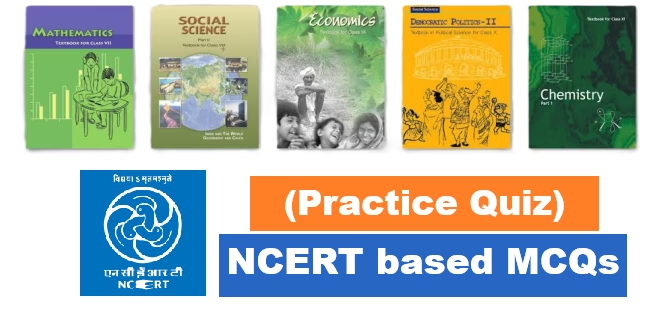
IConceptual understanding of all the topics is the most important part of preparation for an examination. CBSE Curriculum based Objective Questions from Class-VI to XII provide an excellent option to test your basic concepts.
The following Quiz consists of questions from NCERT Class XI India Constitution at Work. Aspirants may practice these questions to have a revision of the fundamental concepts of the subject.
Quiz-summary
0 of 62 questions completed
Questions:
- 1
- 2
- 3
- 4
- 5
- 6
- 7
- 8
- 9
- 10
- 11
- 12
- 13
- 14
- 15
- 16
- 17
- 18
- 19
- 20
- 21
- 22
- 23
- 24
- 25
- 26
- 27
- 28
- 29
- 30
- 31
- 32
- 33
- 34
- 35
- 36
- 37
- 38
- 39
- 40
- 41
- 42
- 43
- 44
- 45
- 46
- 47
- 48
- 49
- 50
- 51
- 52
- 53
- 54
- 55
- 56
- 57
- 58
- 59
- 60
- 61
- 62
Information
Please fill your name and email id to start the Quiz.
You must specify a text. | |
You must specify a text. |
You have already completed the quiz before. Hence you can not start it again.
Quiz is loading...
You must sign in or sign up to start the quiz.
You have to finish following quiz, to start this quiz:
Results
0 of 62 questions answered correctly
Your time:
Time has elapsed
You have reached 0 of 0 points, (0)
Categories
- NCERT 0%
Well done! Keep practicing.
To see yourself in the leader board, click on ‘Send’ then ‘Show leaderboard’.
| Pos. | Name | Entered on | Points | Result |
|---|---|---|---|---|
| Table is loading | ||||
| No data available | ||||
- 1
- 2
- 3
- 4
- 5
- 6
- 7
- 8
- 9
- 10
- 11
- 12
- 13
- 14
- 15
- 16
- 17
- 18
- 19
- 20
- 21
- 22
- 23
- 24
- 25
- 26
- 27
- 28
- 29
- 30
- 31
- 32
- 33
- 34
- 35
- 36
- 37
- 38
- 39
- 40
- 41
- 42
- 43
- 44
- 45
- 46
- 47
- 48
- 49
- 50
- 51
- 52
- 53
- 54
- 55
- 56
- 57
- 58
- 59
- 60
- 61
- 62
- Answered
- Review
- Question 1 of 62
1. Question
Category: NCERTWhich country has the unwritten constitution
CorrectBritain
IncorrectBritain
- Question 2 of 62
2. Question
Category: NCERTWhich country has the brighest constitution
CorrectUSA
IncorrectUSA
- Question 3 of 62
3. Question
Category: NCERTIn which part of the Constitution fundamental Rights are described?
CorrectPart III
IncorrectPart III
- Question 4 of 62
4. Question
Category: NCERTIn which Part Directive Principles of State Policy are described?
CorrectPart IV
IncorrectPart IV
- Question 5 of 62
5. Question
Category: NCERTWho conducts the elections in India?
CorrectElection Commission
IncorrectElection Commission
- Question 6 of 62
6. Question
Category: NCERTWhat is the minimum voting age in India
Correct18 years
Incorrect18 years
- Question 7 of 62
7. Question
Category: NCERTWho appoints the chief Election Commissioner?
CorrectPresident
IncorrectPresident
- Question 8 of 62
8. Question
Category: NCERTIndia has
CorrectParliamentary executive
IncorrectParliamentary executive
- Question 9 of 62
9. Question
Category: NCERTIn Parliamentary executive, Council of ministers is responsible for
CorrectParliament
IncorrectParliament
- Question 10 of 62
10. Question
Category: NCERTPrime minister is appointed by
CorrectPresident
IncorrectPresident
- Question 11 of 62
11. Question
Category: NCERTMaximum number of seats of Lok Sabha can be
Correct550
Incorrect550
- Question 12 of 62
12. Question
Category: NCERTTotal strength of Rajya Sabha is
Correct250
Incorrect250
- Question 13 of 62
13. Question
Category: NCERTFirst speaker of Lok Aabha was
CorrectG.V. Mavlankar
IncorrectG.V. Mavlankar
- Question 14 of 62
14. Question
Category: NCERTThe number of Judges is Supreme Court of India is
Correct26
Incorrect26
- Question 15 of 62
15. Question
Category: NCERTWhich is not the issue of original jurisdiction of Supreme Court of India
CorrectTo give opinion to president
IncorrectTo give opinion to president
- Question 16 of 62
16. Question
Category: NCERTWhere is H.Q. of Supreme Court of India
CorrectNew Delhi
IncorrectNew Delhi
- Question 17 of 62
17. Question
Category: NCERTFederalism stands for
CorrectDecentralisation of power
IncorrectDecentralisation of power
- Question 18 of 62
18. Question
Category: NCERTIndia is ‘Union of States’ which is taken from
CorrectCanada
IncorrectCanada
- Question 19 of 62
19. Question
Category: NCERTNumber of states in India are
Correct28
Incorrect28
- Question 20 of 62
20. Question
Category: NCERTWhich of the following played important role in the development of local government?
CorrectLord Rippon
IncorrectLord Rippon
- Question 21 of 62
21. Question
Category: NCERTWhich is the first state in India to implement Panchayati Raj?
CorrectRajasthan
IncorrectRajasthan
- Question 22 of 62
22. Question
Category: NCERTWhich city of Haryana has Municipal Corporation?
CorrectFaridabad
IncorrectFaridabad
- Question 23 of 62
23. Question
Category: NCERTConstitution of India was completed in
Correct1949 (26th November)
Incorrect1949 (26th November)
- Question 24 of 62
24. Question
Category: NCERTAmendment process of the constitution is given in
CorrectArt 368
IncorrectArt 368
- Question 25 of 62
25. Question
Category: NCERTIndian Constitution is
CorrectWritten, flexible and rigid
IncorrectWritten, flexible and rigid
- Question 26 of 62
26. Question
Category: NCERTWhich of the justice is not given in Preamble?
CorrectReligious justice
IncorrectReligious justice
- Question 27 of 62
27. Question
Category: NCERTFrom which country we have taken Preamble?
CorrectU.S.A
IncorrectU.S.A
- Question 28 of 62
28. Question
Category: NCERTWhich of the following word is not mentioned In Indian constitution:
CorrectFederal
IncorrectFederal
- Question 29 of 62
29. Question
Category: NCERTThe ideal of ‘International Peace’ has found place in:
CorrectThe ideal of International Peace is mentioned in the Directive Principles of State Policy (DPSP).
IncorrectThe ideal of International Peace is mentioned in the Directive Principles of State Policy (DPSP).
- Question 30 of 62
30. Question
Category: NCERTWith respect to Elections in India, who decides which Constituency is to be reserved for Scheduled Castes and Scheduled Tribes?
CorrectThe Delimitation Commission decides which constituency is reserved for SCs and STs.
IncorrectThe Delimitation Commission decides which constituency is reserved for SCs and STs.
- Question 31 of 62
31. Question
Category: NCERTConsider the following statements with regard to the President of India.
1. The President does not exercise discretion on advice of Council of Ministers.
2. All members of Legislative Assemblies and both Houses of Parliament take part in electing the President.
3. The President’s ordinance making power is not discretionary.
Which of the above statements is/are correct?CorrectStatements 1 and 3 are correct; Statement 2 is incorrect (only elected MLAs and MPs participate).
IncorrectStatements 1 and 3 are correct; Statement 2 is incorrect (only elected MLAs and MPs participate).
- Question 32 of 62
32. Question
Category: NCERTWhich among the following is true regarding amendments of the constitution with provisions affecting federal character?
CorrectSuch amendments require 2/3 majority in Parliament plus ratification by at least half of the states.
IncorrectSuch amendments require 2/3 majority in Parliament plus ratification by at least half of the states.
- Question 33 of 62
33. Question
Category: NCERTThe Supreme Court would issue a writ of Habeas Corpus generally when there is violation of rights given by which Article?
CorrectHabeas Corpus protects personal liberty under Article 21.
IncorrectHabeas Corpus protects personal liberty under Article 21.
- Question 34 of 62
34. Question
Category: NCERTConsider the following statements about eleventh schedule of the constitution:
1. 29 subjects earlier in State List are identified and listed.
2. These subjects are linked to development and welfare functions at local level.
3. It is mandatory for state legislation to transfer all subjects to local bodies within time limit.CorrectStatements 1 and 2 are correct; Statement 3 is incorrect (transfer is not mandatory).
IncorrectStatements 1 and 2 are correct; Statement 3 is incorrect (transfer is not mandatory).
- Question 35 of 62
35. Question
Category: NCERTConsider the following statements regarding Vice President of India.
1. Elected in same manner as President.
2. May be removed by Lok Sabha resolution agreed by Rajya Sabha.
3. Takes over office of President till expiration of term.
Which are incorrect?CorrectStatements 1 and 3 are incorrect; removal is by Rajya Sabha only, and VP acts as President temporarily until new election.
IncorrectStatements 1 and 3 are incorrect; removal is by Rajya Sabha only, and VP acts as President temporarily until new election.
- Question 36 of 62
36. Question
Category: NCERTA democratic polity is based on doctrine of popular sovereignty. Which of the following are used in direct democracy?
1. Plebiscite
2. Referendum
3. Recall
4. InitiativeCorrectAll four — plebiscite, referendum, recall, and initiative — are instruments of direct democracy.
IncorrectAll four — plebiscite, referendum, recall, and initiative — are instruments of direct democracy.
- Question 37 of 62
37. Question
Category: NCERTConsider the following statements:
1. Freedom of Religion includes freedom not to follow any religion.
2. Government cannot impose restrictions on practice of religion.
3. Government can discriminate based on religion in public employment.
Which are incorrect?CorrectStatements 2 and 3 are incorrect; government can regulate religion for social reform and cannot discriminate in employment.
IncorrectStatements 2 and 3 are incorrect; government can regulate religion for social reform and cannot discriminate in employment.
- Question 38 of 62
38. Question
Category: NCERTIn so far as the Constitution of India is concerned, minority status is recognized on which of the following grounds?
1. Religion
2. Language
3. CultureCorrectMinority status is recognized on all three grounds — religion, language, and culture.
IncorrectMinority status is recognized on all three grounds — religion, language, and culture.
- Question 39 of 62
39. Question
Category: NCERTWhich of the following provisions under the Constitution of India has been recognized as ‘Heart and Soul of the Constitution’?
CorrectThe Right to Constitutional Remedy is recognized as the ‘Heart and Soul of the Constitution’.
IncorrectThe Right to Constitutional Remedy is recognized as the ‘Heart and Soul of the Constitution’.
- Question 40 of 62
40. Question
Category: NCERTWhich of the following statements is not correct?
1. Constitution forbids employment of children below 14 years in dangerous jobs.
2. Freedom of religion is not unlimited; govt. can interfere to root out social evils.
3. Constitution allows conversions in India.
4. All minorities can set up their own educational institutions.CorrectAll four statements are correct; hence option ‘None’ is the right answer.
IncorrectAll four statements are correct; hence option ‘None’ is the right answer.
- Question 41 of 62
41. Question
Category: NCERTWhich of the following principles of secularism are adopted in the Constitution of India?
1. State will have nothing to do with religion.
2. State will have close relation with religion.
3. State can discriminate among religions.
4. State will recognize rights of religious groups.
5. State will have limited powers to intervene in affairs of religions.CorrectPrinciples 1,4 and 5 are adopted in the Constitution of India.
IncorrectPrinciples 1,4 and 5 are adopted in the Constitution of India.
- Question 42 of 62
42. Question
Category: NCERT42nd Amendment was one of the most controversial Amendments. Which were the reasons?
1. Made during National Emergency.
2. Made without support of special majority.
3. Made without ratification by states.CorrectAll three reasons made the 42nd Amendment controversial.
IncorrectAll three reasons made the 42nd Amendment controversial.
- Question 43 of 62
43. Question
Category: NCERTWhich of the following statements is/are not correct?
1. FPTP system is followed for all elections.
2. ECI does not supervise Panchayat/Municipal elections.
3. President cannot remove Election Commissioner.
4. Appointment of more than one Election Commissioner is mandatory.CorrectStatements 1,3 and 4 are not correct.
IncorrectStatements 1,3 and 4 are not correct.
- Question 44 of 62
44. Question
Category: NCERTConsider the following statements in the context of First Past the Post system of Election.
1. Candidate with more votes is elected.
2. FPTP is also called Plurality System.
3. FPTP is not prescribed in the Constitution.CorrectAll three statements are correct.
IncorrectAll three statements are correct.
- Question 45 of 62
45. Question
Category: NCERTConsider the following statements in the context of Local Governments.
1. Reservation of seats apply only to ordinary members, not Chairpersons.
2. Reservation for women is restricted to general seats, not SC/ST.
Which is correct?CorrectBoth statements are incorrect; reservations apply to chairpersons and SC/ST seats too.
IncorrectBoth statements are incorrect; reservations apply to chairpersons and SC/ST seats too.
- Question 46 of 62
46. Question
Category: NCERTAs per Advisory Jurisdiction (Art.143), President can refer matters to SC. Consider:
1. President empowered to seek advice (not available in US).
2. SC is bound to give advice.
3. President & Council bound to act on advice.
Which are correct?CorrectOnly Statement 1 is correct; SC advice is not binding.
IncorrectOnly Statement 1 is correct; SC advice is not binding.
- Question 47 of 62
47. Question
Category: NCERTConsider the following statements in the context of Council of Ministers.
1. No-confidence against a single minister leads to resignation of that minister only.
2. Resignation of PM brings down the Council of Ministers.CorrectBoth statements are correct.
IncorrectBoth statements are correct.
- Question 48 of 62
48. Question
Category: NCERTConsider the following statements:
1. Promotion of Uniform Civil Code.
2. Prohibition of alcoholic liquor.
3. Promotion of cottage industries.
4. Promotion of International peace.
Which of the above are explicitly mentioned in the Indian Constitution?CorrectAll four are explicitly mentioned in the Directive Principles of State Policy.
IncorrectAll four are explicitly mentioned in the Directive Principles of State Policy.
- Question 49 of 62
49. Question
Category: NCERTConsider the following statements in the context of State Re-organization in India:
1. Implementation of SRC Report created 15 new states and 6 UTs.
2. Gujarat and Maharashtra were created in 1966, Punjab and Haryana separated in 1960.CorrectBoth statements are incorrect; Gujarat & Maharashtra were created in 1960, Punjab & Haryana in 1966.
IncorrectBoth statements are incorrect; Gujarat & Maharashtra were created in 1960, Punjab & Haryana in 1966.
- Question 50 of 62
50. Question
Category: NCERTWhich of the following statements is correct regarding the Constituent Assembly of Nepal?
CorrectNepal faced repeated constitution-making challenges; multiple constitutions were granted by the King.
IncorrectNepal faced repeated constitution-making challenges; multiple constitutions were granted by the King.
- Question 51 of 62
51. Question
Category: NCERTWhich of the following statements is correct about the Jute industry in India?
CorrectProblems include inadequate raw material, obsolete machinery, and competition from substitutes.
IncorrectProblems include inadequate raw material, obsolete machinery, and competition from substitutes.
- Question 52 of 62
52. Question
Category: NCERTCoal reserves in India occur in which river valleys?
1. Godavari
2. Mahanadi
3. Damodar
4. SonCorrectCoal reserves occur in all four valleys.
IncorrectCoal reserves occur in all four valleys.
- Question 53 of 62
53. Question
Category: NCERTArrange the following events towards sustainable development chronologically:
1. Our Common Future
2. Limits to Growth
3. Agenda-21 report of Rio ConferenceCorrectCorrect order is 2-1-3.
IncorrectCorrect order is 2-1-3.
- Question 54 of 62
54. Question
Category: NCERTThe Diamond Quadrilateral project of Indian Railways aims to connect which cities?
1. Delhi
2. Kolkata
3. Bengaluru
4. MumbaiCorrectIt connects Delhi, Kolkata, Mumbai, and Chennai (not Bengaluru).
IncorrectIt connects Delhi, Kolkata, Mumbai, and Chennai (not Bengaluru).
- Question 55 of 62
55. Question
Category: NCERTConsider the following statements regarding shale Gas:
1. Formed during transformation into coal.
2. Largest reserves are in India.CorrectBoth statements are incorrect; shale gas is in sedimentary rocks, and India does not have largest reserves.
IncorrectBoth statements are incorrect; shale gas is in sedimentary rocks, and India does not have largest reserves.
- Question 56 of 62
56. Question
Category: NCERTWhich of the following statements is correct about Panchayati Raj?
CorrectThe 73rd Amendment gave constitutional status to Panchayati Raj institutions.
IncorrectThe 73rd Amendment gave constitutional status to Panchayati Raj institutions.
- Question 57 of 62
57. Question
Category: NCERTWhich of the following leaders gave the slogan ‘Garibi Hatao’?
CorrectIndira Gandhi gave the slogan ‘Garibi Hatao’.
IncorrectIndira Gandhi gave the slogan ‘Garibi Hatao’.
- Question 58 of 62
58. Question
Category: NCERTWhich of the following leaders gave the slogan ‘Jai Jawan Jai Kisan’?
CorrectLal Bahadur Shastri gave the slogan ‘Jai Jawan Jai Kisan’.
IncorrectLal Bahadur Shastri gave the slogan ‘Jai Jawan Jai Kisan’.
- Question 59 of 62
59. Question
Category: NCERTWhich of the following leaders gave the slogan ‘Do or Die’?
CorrectMahatma Gandhi gave the slogan ‘Do or Die’ during the Quit India Movement in 1942.
IncorrectMahatma Gandhi gave the slogan ‘Do or Die’ during the Quit India Movement in 1942.
- Question 60 of 62
60. Question
Category: NCERTWhich of the following leaders gave the slogan ‘Inquilab Zindabad’?
CorrectBhagat Singh popularized the slogan ‘Inquilab Zindabad’.
IncorrectBhagat Singh popularized the slogan ‘Inquilab Zindabad’.
- Question 61 of 62
61. Question
Category: NCERTWhich of the following leaders gave the slogan ‘Jai Hind’?
CorrectSubhas Chandra Bose gave the slogan ‘Jai Hind’.
IncorrectSubhas Chandra Bose gave the slogan ‘Jai Hind’.
- Question 62 of 62
62. Question
Category: NCERTWhich of the following leaders gave the slogan ‘Jai Hind Jai Vidwan Jai Kisan’?
CorrectNarendra Modi gave the slogan ‘Jai Hind Jai Vidwan Jai Kisan’.
IncorrectNarendra Modi gave the slogan ‘Jai Hind Jai Vidwan Jai Kisan’.