 Hindi
Hindi Home
Home Syllabus
 About Us
 Contact Us
Conceptual understanding of all the topics is the most important part of preparation for an examination. CBSE Curriculum based Objective Questions from Class-VI to XII provide an excellent option to test your basic concepts.
The following Quiz consists of questions from NCERT Class X Geography. Aspirants may practice these questions to have a revision of the fundamental concepts of the subject.
Quiz-summary
0 of 104 questions completed
Questions:
- 1
- 2
- 3
- 4
- 5
- 6
- 7
- 8
- 9
- 10
- 11
- 12
- 13
- 14
- 15
- 16
- 17
- 18
- 19
- 20
- 21
- 22
- 23
- 24
- 25
- 26
- 27
- 28
- 29
- 30
- 31
- 32
- 33
- 34
- 35
- 36
- 37
- 38
- 39
- 40
- 41
- 42
- 43
- 44
- 45
- 46
- 47
- 48
- 49
- 50
- 51
- 52
- 53
- 54
- 55
- 56
- 57
- 58
- 59
- 60
- 61
- 62
- 63
- 64
- 65
- 66
- 67
- 68
- 69
- 70
- 71
- 72
- 73
- 74
- 75
- 76
- 77
- 78
- 79
- 80
- 81
- 82
- 83
- 84
- 85
- 86
- 87
- 88
- 89
- 90
- 91
- 92
- 93
- 94
- 95
- 96
- 97
- 98
- 99
- 100
- 101
- 102
- 103
- 104
Information
Please fill your name and email id to start the Quiz.
You have already completed the quiz before. Hence you can not start it again.
Quiz is loading...
You must sign in or sign up to start the quiz.
You have to finish following quiz, to start this quiz:
Results
0 of 104 questions answered correctly
Your time:
Time has elapsed
You have reached 0 of 0 points, (0)
Categories
- NCERT 0%
Well done! Keep practicing.
To see yourself in the leader board, click on ‘Send’ then ‘Show leaderboard’.
| Pos. | Name | Entered on | Points | Result |
|---|---|---|---|---|
| Table is loading | ||||
| No data available | ||||
- 1
- 2
- 3
- 4
- 5
- 6
- 7
- 8
- 9
- 10
- 11
- 12
- 13
- 14
- 15
- 16
- 17
- 18
- 19
- 20
- 21
- 22
- 23
- 24
- 25
- 26
- 27
- 28
- 29
- 30
- 31
- 32
- 33
- 34
- 35
- 36
- 37
- 38
- 39
- 40
- 41
- 42
- 43
- 44
- 45
- 46
- 47
- 48
- 49
- 50
- 51
- 52
- 53
- 54
- 55
- 56
- 57
- 58
- 59
- 60
- 61
- 62
- 63
- 64
- 65
- 66
- 67
- 68
- 69
- 70
- 71
- 72
- 73
- 74
- 75
- 76
- 77
- 78
- 79
- 80
- 81
- 82
- 83
- 84
- 85
- 86
- 87
- 88
- 89
- 90
- 91
- 92
- 93
- 94
- 95
- 96
- 97
- 98
- 99
- 100
- 101
- 102
- 103
- 104
- Answered
- Review
- Question 1 of 104
1. Question
Category: NCERTConsider the following statements about renewable and non-renewable resources:
1. Renewable resources can be reproduced by physical as well as chemical processes.
2. Non-renewable resources take millions of years for the formation.
Which of the above statements is/are incorrect?CorrectRenewable Resources: The resources which can be renewed or reproduced by physical, chemical or mechanical processes.
IncorrectRenewable Resources: The resources which can be renewed or reproduced by physical, chemical or mechanical processes.
- Question 2 of 104
2. Question
Category: NCERTMatch the following pairs:
Water Zone : Distance from Baseline
1. Exclusive Economic zone A. 12 nautical miles
2. Continues zones. B. 24 nautical miles
3. Territorial waters. C. 200 nautical miles
Choose the correct code from the below:CorrectTerritorial sea, as defined by the 1982 United Nations Convention on the Law of the Sea
 Incorrect
Territorial sea, as defined by the 1982 United Nations Convention on the Law of the Sea
- Question 3 of 104
3. Question
Category: NCERT“There is enough for everybody’s need and not for any body’s greed”, who among the following has given the above statement?
CorrectMahatma Gandhi’s quote calls for sustainable practices and a mindful approach to resource utilization, urging individuals and communities to promote minimalism and share resources fairly.
IncorrectMahatma Gandhi’s quote calls for sustainable practices and a mindful approach to resource utilization, urging individuals and communities to promote minimalism and share resources fairly.
- Question 4 of 104
4. Question
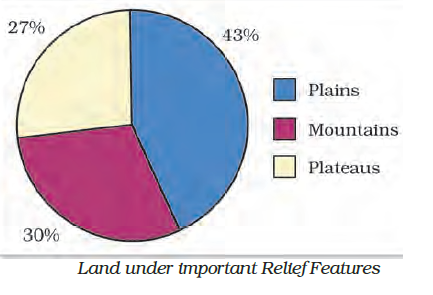
Category: NCERTArrange the following land relief features in ascending order of percentage of land area in India:
1. Plains
2. Mountain
3. Plateaus
Choose the correct code from the below:CorrectIncorrect - Question 5 of 104
5. Question
Category: NCERTWhich one of the following statements is true about the term resources?
CorrectResources are a function of human activities.
IncorrectResources are a function of human activities.
- Question 6 of 104
6. Question
Category: NCERTConsider the following statements about renewable and non-renewable resources:
1. Renewable resources can be reproduced by physical as well as chemical processes.
2. Non-renewable resources take millions of years for formation.
Which are incorrect?CorrectStatement 1 is incorrect; Statement 2 is correct.
IncorrectStatement 1 is incorrect; Statement 2 is correct.
- Question 7 of 104
7. Question
Category: NCERTRegarding Exclusive Economic Zone, consider:
1. It extends 12 nautical miles.
2. Coastal state and international institutions have joint jurisdiction.
Which are correct?CorrectNeither statement is correct; EEZ extends 200 nautical miles and jurisdiction lies with coastal state.
IncorrectNeither statement is correct; EEZ extends 200 nautical miles and jurisdiction lies with coastal state.
- Question 8 of 104
8. Question
Category: NCERTMatch the following pairs:
Exclusive Economic Zone – 200 nautical miles
Continues Zone – 24 nautical miles
Territorial waters – 12 nautical milesCorrectCorrect match is 1(C)-2(B)-3(A).
IncorrectCorrect match is 1(C)-2(B)-3(A).
- Question 9 of 104
9. Question
Category: NCERTResources surveyed with quality and quantity determined for utilisation are known as:
CorrectThey are called Developed resources.
IncorrectThey are called Developed resources.
- Question 10 of 104
10. Question
Category: NCERTConsider the following about Earth Summit:
1. Held at Rio de Janeiro in Brazil in 1991.
2. Declaration on climate change and biodiversity was outcome.
3. Adopted Agenda 21 for third world development.
Which are correct?CorrectStatement 2 is correct; Statements 1 and 3 are incorrect (Summit held in 1992, Agenda 21 for sustainable development).
IncorrectStatement 2 is correct; Statements 1 and 3 are incorrect (Summit held in 1992, Agenda 21 for sustainable development).
- Question 11 of 104
11. Question
Category: NCERTWhich of the following statement is incorrect about Agenda 21?
CorrectNone of the given statements are incorrect; Agenda 21 is indeed outcome of UNCED, aims at sustainable development, and requires local agenda.
IncorrectNone of the given statements are incorrect; Agenda 21 is indeed outcome of UNCED, aims at sustainable development, and requires local agenda.
- Question 12 of 104
12. Question
Category: NCERTResource planning in India involves:
1. Identification and inventory of resources.
2. Planning structures with technology and institutions.
3. Matching resource plans with local development plans only.CorrectStatements 1 and 2 are correct; Statement 3 is incorrect (plans matched with national development too).
IncorrectStatements 1 and 2 are correct; Statement 3 is incorrect (plans matched with national development too).
- Question 13 of 104
13. Question
Category: NCERT“There is enough for everybody’s need and not for anybody’s greed” — who said this?
CorrectMahatma Gandhi gave this statement.
IncorrectMahatma Gandhi gave this statement.
- Question 14 of 104
14. Question
Category: NCERTConsider the following events in resource conservation:
1. Club of Rome advocated systematic conservation.
2. Brundtland Commission introduced sustainable development.
Which are incorrect?CorrectNeither statement is incorrect; both are correct.
IncorrectNeither statement is incorrect; both are correct.
- Question 15 of 104
15. Question
Category: NCERTArrange the following land relief features in ascending order of percentage of land area in India:
1. Plains
2. Mountain
3. PlateausCorrectCorrect order is 3-1-2 (Plateaus < Plains < Mountains).
IncorrectCorrect order is 3-1-2 (Plateaus < Plains < Mountains).
- Question 16 of 104
16. Question
Category: NCERTRegarding changing land use pattern in India:
1. Net sown area in 2014 decreased compared to 1960s.
2. Barren and waste land increased in 2014 compared to 1960s.
3. Forest area cover increased after 1960s.
Which are correct?CorrectStatements 1 and 3 are correct; Statement 2 is incorrect.
IncorrectStatements 1 and 3 are correct; Statement 2 is incorrect.
- Question 17 of 104
17. Question
Category: NCERTChanging land use pattern in India:
1. Area under non-agricultural uses increased nearly thrice in 2014 compared to 1960s.
2. Permanent pasture and grazing land use increased in 2014 compared to 1960s.
Which are incorrect?CorrectStatement 2 is incorrect; Statement 1 is correct.
IncorrectStatement 2 is incorrect; Statement 1 is correct.
- Question 18 of 104
18. Question
Category: NCERTConsider the following statements about forest cover in India:
1. National forest policy of 1952 envisages 33% forest area cover.
2. India’s forest cover increasing since last decade.
Which are correct?CorrectBoth statements are correct.
IncorrectBoth statements are correct.
- Question 19 of 104
19. Question
Category: NCERTMatch the following pairs about causes of land degradation and affected regions:
1. Overgrazing – Gujarat & Maharashtra
2. Over irrigation – Punjab & Haryana
3. Mining – Orissa & Madhya PradeshCorrectCorrect match is 1(A)-2(B)-3(C).
IncorrectCorrect match is 1(A)-2(B)-3(C).
- Question 20 of 104
20. Question
Category: NCERTArrange the following causes of land degradation in ascending order:
1. Water eroded area
2. Wind eroded area
3. Saline and alkaline land
4. Forest degraded areaCorrectCorrect order is 4-3-1-2.
IncorrectCorrect order is 4-3-1-2.
- Question 21 of 104
21. Question
Category: NCERTWhich of the following methods can be used for solving land degradation problems in arid regions?
1. Planting shelter belts
2. Growing thorny bushes
3. Controlling overgrazing
4. Stabilisation of sand dunesCorrectAll four methods can be used.
IncorrectAll four methods can be used.
- Question 22 of 104
22. Question
Category: NCERTConsidering soil as a resource:
1. Soil is an important non-renewable resource.
2. Soil is a living system.
3. It takes millions of years to form soil up to a few cm depth.
Which are correct?CorrectAll three statements are correct.
IncorrectAll three statements are correct.
- Question 23 of 104
23. Question
Category: NCERTWhich of the following forces contribute to soil formation?
1. Change in temperature
2. Glacier
3. Wind
4. Activity by decomposers
5. Running waterCorrectAll five forces contribute to soil formation.
IncorrectAll five forces contribute to soil formation.
- Question 24 of 104
24. Question
Category: NCERTWhich of the following factors are important in soil formation?
1. Time
2. Parent Rock
3. Climate
4. Relief
5. Living beingsCorrectAll five factors are important in soil formation.
IncorrectAll five factors are important in soil formation.
- Question 25 of 104
25. Question
Category: NCERTConsider the following statements about Alluvial soil in India:
1. It is most widely spread soil in India after Red and yellow soil.
2. These soils found at entire northern plains and also extend upto Rajasthan and Gujarat.
3. This soil contains adequate proportion of potash, phosphate and lime.
Which are incorrect?CorrectStatement 1 is incorrect; Alluvial soil is the most widely spread soil in India.
IncorrectStatement 1 is incorrect; Alluvial soil is the most widely spread soil in India.
- Question 26 of 104
26. Question
Category: NCERTConsider the following features of soil:
1. Duars
2. Chos
Above feature represents which soil?CorrectThese features represent Alluvial soil.
IncorrectThese features represent Alluvial soil.
- Question 27 of 104
27. Question
Category: NCERTRegarding classification of alluvial soil:
1. Old soil is Bangar, new soil is Khadar.
2. Khadar soil has more kankar nodules than Bangar.
3. Bangar soil has more fine particles and is more fertile than Bangar.
Which are correct?CorrectStatement 1 is correct; Statements 2 and 3 are incorrect.
IncorrectStatement 1 is correct; Statements 2 and 3 are incorrect.
- Question 28 of 104
28. Question
Category: NCERTConsider the following statements about black soil:
1. It is also called regur soil.
2. It is made up of coarse materials.
3. These soils generally rich in phosphoric contents.
Which are incorrect?CorrectStatements 2 and 3 are incorrect; black soil is fine textured and poor in phosphoric content.
IncorrectStatements 2 and 3 are incorrect; black soil is fine textured and poor in phosphoric content.
- Question 29 of 104
29. Question
Category: NCERTThe black soils is rich in nutrients. Which nutrients are abundantly present?
1. Lime
2. Potash
3. Calcium carbonate
4. Phosphorus
5. MagnesiumCorrectBlack soil is rich in lime, potash, calcium carbonate, and magnesium.
IncorrectBlack soil is rich in lime, potash, calcium carbonate, and magnesium.
- Question 30 of 104
30. Question
Category: NCERTWhich of the following statements is incorrect about black soil?
CorrectStatement b is incorrect; black soil has high moisture retention capacity.
IncorrectStatement b is incorrect; black soil has high moisture retention capacity.
- Question 31 of 104
31. Question
Category: NCERTConsider the following statements about Red soil:
1. Develops on crystalline igneous rock of high rainfall region.
2. Reddish colour due to iron diffusion.
3. Looks yellow when hydrated.
Which are correct?CorrectAll three statements are correct.
IncorrectAll three statements are correct.
- Question 32 of 104
32. Question
Category: NCERTConsider the following statements about Laterite soil:
1. Develops under tropical/subtropical climate due to continuous rainfall.
2. Result of intense leaching.
3. Mostly basic in nature and rich in humus.
Which are incorrect?CorrectStatement 3 is incorrect; laterite soil is acidic and poor in humus.
IncorrectStatement 3 is incorrect; laterite soil is acidic and poor in humus.
- Question 33 of 104
33. Question
Category: NCERTWhich of the following features is incorrect about Laterite soil?
CorrectStatement b is incorrect; laterite soil is poor in plant nutrients.
IncorrectStatement b is incorrect; laterite soil is poor in plant nutrients.
- Question 34 of 104
34. Question
Category: NCERTWhich of the following features shown by arid soil?
1. Red and brown colour
2. Silt texture
3. Lacks humus and moisture
4. Lower horizon occupied by kankarCorrectAll four features are shown by arid soil.
IncorrectAll four features are shown by arid soil.
- Question 35 of 104
35. Question
Category: NCERTConsider the following statements about forest soils:
1. Soil texture varies from loamy in valley sides and coarse grained in upper slopes.
2. In snow covered areas this soil is acidic in nature.
Which are correct?CorrectBoth statements are correct.
IncorrectBoth statements are correct.
- Question 36 of 104
36. Question
Category: NCERTRegarding soil erosion and their processes:
1. Denudation of soil cover and washing down is soil erosion.
2. Soil degradation starts after soil formation.
Which are correct?CorrectBoth statements are correct.
IncorrectBoth statements are correct.
- Question 37 of 104
37. Question
Category: NCERTWhich of the following is the measure for soil conservation?
1. Contour ploughing
2. Strip cropping
3. Terrace cultivation
4. Shelter beltsCorrectAll four are measures for soil conservation.
IncorrectAll four are measures for soil conservation.
- Question 38 of 104
38. Question
Category: NCERTSoil is formed by the process of:
CorrectSoil is formed by the process of Weathering.
IncorrectSoil is formed by the process of Weathering.
- Question 39 of 104
39. Question
Category: NCERTThe arrangement of soil in different horizons is known as:
CorrectIt is known as Soil profile.
IncorrectIt is known as Soil profile.
- Question 40 of 104
40. Question
Category: NCERTWhat percentage of India’s wild flora and mammals are on threatened list?
Correct10 percent of India’s recorded wild flora and 20 percent of mammals are threatened.
Incorrect10 percent of India’s recorded wild flora and 20 percent of mammals are threatened.
- Question 41 of 104
41. Question
Category: NCERTWhich of the following fauna categorised as critical, on verge of extinction?
1. Cheetah
2. Pink-headed duck
3. Mountain quail
4. Forest spotted owletCorrectAll four species are categorised as critical.
IncorrectAll four species are categorised as critical.
- Question 42 of 104
42. Question
Category: NCERTArrange the following classification of forest in ascending order of percentage:
1. Open forest
2. Dense forest
3. MangroveCorrectCorrect order is 3-2-1 (Mangrove < Dense < Open).
IncorrectCorrect order is 3-2-1 (Mangrove < Dense < Open).
- Question 43 of 104
43. Question
Category: NCERTWhich of the following are categorised as Endangered species by IUCN?
1. Black buck
2. Asiatic elephant
3. Indian rhino
4. SangaiCorrectAll four species are categorised as Endangered.
IncorrectAll four species are categorised as Endangered.
- Question 44 of 104
44. Question
Category: NCERTMatch the following animals with their category of existence:
1. Pink-headed duck – Extinct
2. Black buck – Vulnerable
3. Asiatic elephant – Endangered
4. Mithun – EndemicCorrectCorrect match is 1(D)-2(B)-3(C)-4(A).
IncorrectCorrect match is 1(D)-2(B)-3(C)-4(A).
- Question 45 of 104
45. Question
Category: NCERTConsider the following statements about Himalayan yew:
1. It is a medicinal plant used to treat cancer patients.
2. In India, it is found in western as well as eastern Himalaya.
3. It is in serious threat due to infrastructure development in Himalaya.
Which are correct?CorrectAll three statements are correct.
IncorrectAll three statements are correct.
- Question 46 of 104
46. Question
Category: NCERTWhich of the following are causes of environmental destruction?
1. Habitat destruction
2. Over population
3. Differential sharing of responsibility
4. Inequitable consumption of resourcesCorrectAll four are causes of environmental destruction.
IncorrectAll four are causes of environmental destruction.
- Question 47 of 104
47. Question
Category: NCERTWhy we need to conserve our forests and wildlife?
1. To preserve genetic diversity
2. To preserve ecological diversity
3. To preserve our life support systemCorrectAll three reasons are correct.
IncorrectAll three reasons are correct.
- Question 48 of 104
48. Question
Category: NCERTConsider the following statements about the Indian Wildlife Protection Act:
1. Implemented in 1972.
2. State-wise list of protected species published.
3. Thrust was towards protecting all endangered species.
Which are incorrect?CorrectStatement 2 is incorrect; the Act provided a national list, not state-wise lists.
IncorrectStatement 2 is incorrect; the Act provided a national list, not state-wise lists.
- Question 49 of 104
49. Question
Category: NCERTConsider following statements about Project Tiger:
1. It is a wildlife campaign launched in 1973.
2. Tiger population in India continuously increasing since launch.
3. Sariska wildlife sanctuary in Madhya Pradesh is an important tiger reserve.
Which are correct?CorrectStatement 1 is correct; Statements 2 and 3 are incorrect (tiger numbers fluctuated, Sariska is in Rajasthan).
IncorrectStatement 1 is correct; Statements 2 and 3 are incorrect (tiger numbers fluctuated, Sariska is in Rajasthan).
- Question 50 of 104
50. Question
Category: NCERTWhich of the following statements about Wildlife Protection Act is incorrect?
CorrectStatement c is incorrect; insects were not added in 1986.
IncorrectStatement c is incorrect; insects were not added in 1986.
- Question 51 of 104
51. Question
Category: NCERTRegarding classification of forest:
1. Forest regarded as most valuable for conservation are protected forest.
2. Protected forest count nearly half of total forest area.
Which are correct?CorrectStatement 2 is correct; Statement 1 is incorrect (reserved forests are most valuable).
IncorrectStatement 2 is correct; Statement 1 is incorrect (reserved forests are most valuable).
- Question 52 of 104
52. Question
Category: NCERTConsider the following statements about status and classification of forest in India:
1. Reserve and protected forests are permanent forest.
2. Chhattisgarh has largest area under permanent forest.
3. North eastern states have high percentage of permanent forest managed by local communities.
Which are correct?CorrectStatements 1 and 3 are correct; Statement 2 is incorrect (Madhya Pradesh has largest area).
IncorrectStatements 1 and 3 are correct; Statement 2 is incorrect (Madhya Pradesh has largest area).
- Question 53 of 104
53. Question
Category: NCERTSacred groves refers to:
CorrectSacred groves are forests left untouched by local people.
IncorrectSacred groves are forests left untouched by local people.
- Question 54 of 104
54. Question
Category: NCERTConsider the following statements about Joint Forest Management (JFM) program:
1. Involves local authorities in management/restoration of degraded forests.
2. Orissa was first to pass resolution on JFM in 1988.
3. JFM involves local institutions undertaking protection activities.
Which are correct?CorrectAll three statements are correct.
IncorrectAll three statements are correct.
- Question 55 of 104
55. Question
Category: NCERTWith reference to growing population and its impact on water scarcity:
1. Large and growing population can lead to water scarcity.
2. Growing population increases demand of water intensive crops.
Which are correct?CorrectBoth statements are correct.
IncorrectBoth statements are correct.
- Question 56 of 104
56. Question
Category: NCERTWith reference to Hydraulic Structures in Ancient India:
1. Dams and irrigation systems developed during Maurya Empire.
2. In 16th century Hauz Khas constructed by Mughals for Siri Fort.
Which are incorrect?CorrectStatement 2 is incorrect; Hauz Khas was built earlier by Alauddin Khilji in 13th century.
IncorrectStatement 2 is incorrect; Hauz Khas was built earlier by Alauddin Khilji in 13th century.
- Question 57 of 104
57. Question
Category: NCERTWhy in recent years, multi-purpose projects and large dams have come under scrutiny?
1. Poor sediment flow
2. Excessive sedimentation at reservoir bottom
3. Adverse effect on aquatic life
4. Loss of biodiversityCorrectAll four reasons are correct.
IncorrectAll four reasons are correct.
- Question 58 of 104
58. Question
Category: NCERTWhich of the following is incorrect about impact of multi-purpose projects and large dams?
CorrectStatement a is incorrect; benefits are not mostly local, they have wider impacts.
IncorrectStatement a is incorrect; benefits are not mostly local, they have wider impacts.
- Question 59 of 104
59. Question
Category: NCERTArrange the following multi-purpose projects/dams from North to South:
1. Nagarjuna Sagar
2. Rana Pratap Sagar
3. Gandhi Sagar
4. PravaraCorrectCorrect order is 3-2-1-4.
IncorrectCorrect order is 3-2-1-4.
- Question 60 of 104
60. Question
Category: NCERTArrange the following multi-purpose projects/dams from West to East:
1. Hirakud
2. Tilaiya
3. Konar
4. RihandCorrectCorrect order is 1-4-2-3.
IncorrectCorrect order is 1-4-2-3.
- Question 61 of 104
61. Question
Category: NCERTMulti-purpose projects caused severe adverse impacts:
1. Causes flood
2. Loss of biodiversity
3. Soil erosion
4. Earthquake
5. Water borne diseasesCorrectAll five impacts are correct.
IncorrectAll five impacts are correct.
- Question 62 of 104
62. Question
Category: NCERTGuls and kuls are traditional methods to channel water for agriculture. In which region are they used?
CorrectThey are used in Western Himalayas.
IncorrectThey are used in Western Himalayas.
- Question 63 of 104
63. Question
Category: NCERTWhich of the following is correct about Khadins and Johads techniques?
CorrectThey are rain-fed structures which allow water to stand and moisten the soil.
IncorrectThey are rain-fed structures which allow water to stand and moisten the soil.
- Question 64 of 104
64. Question
Category: NCERTTraditional systems of underground storage of drinking water is called:
CorrectIt is called Tanka.
IncorrectIt is called Tanka.
- Question 65 of 104
65. Question
Category: NCERTTraditional Bamboo irrigation system is prevalent in which of states in India?
CorrectIt is prevalent in Meghalaya.
IncorrectIt is prevalent in Meghalaya.
- Question 66 of 104
66. Question
Category: NCERTWhich of the following states in India first and only state which has made roof top rainwater harvesting mandatory to all houses?
CorrectTamil Nadu is the first and only state to make rooftop rainwater harvesting mandatory.
IncorrectTamil Nadu is the first and only state to make rooftop rainwater harvesting mandatory.
- Question 67 of 104
67. Question
Category: NCERTWhich of the following pair is/are incorrectly matched?
1. Dahiya – Madhya Pradesh
2. Pama Dabi – Odisha
3. Khil – Rajasthan
4. Jhumming – North East RegionCorrectPairs 1 and 2 are incorrectly matched.
IncorrectPairs 1 and 2 are incorrectly matched.
- Question 68 of 104
68. Question
Category: NCERTConsider the following statements about Intensive subsistence farming:
1. Practised in dense population regions.
2. It is labour-intensive farming.
3. Productivity is less to moderate.
Which are correct?CorrectAll three statements are correct.
IncorrectAll three statements are correct.
- Question 69 of 104
69. Question
Category: NCERTConsider the following statements about tea plantation in India:
1. Tea requires tropical and sub-tropical climates.
2. Requires warm, moist, frost-free climate all year.
3. Tea in Assam and Western Himalaya are important plantation crops.
Which are correct?CorrectAll three statements are correct.
IncorrectAll three statements are correct.
- Question 70 of 104
70. Question
Category: NCERTConsider the following statements about wheat crop in India:
1. Main food crop in Northern and North East India.
2. Requires bright sunshine at growing season and cool weather at ripening.
3. Requires more than 70–75 cm annual rainfall evenly distributed.
Which are incorrect?CorrectStatements 1 and 3 are incorrect; wheat is mainly grown in North/North-West India and requires 50–75 cm rainfall.
IncorrectStatements 1 and 3 are incorrect; wheat is mainly grown in North/North-West India and requires 50–75 cm rainfall.
- Question 71 of 104
71. Question
Category: NCERTConsider the following statements about millets crops in India:
1. Jowar, Bajra and Ragi are important millets.
2. Millets mostly produced where irrigation facilities available.
3. They have very high nutritional value.
Which are correct?CorrectStatements 1 and 3 are correct; Statement 2 is incorrect (millets are grown in dry regions).
IncorrectStatements 1 and 3 are correct; Statement 2 is incorrect (millets are grown in dry regions).
- Question 72 of 104
72. Question
Category: NCERTRegarding pulses:
1. India is largest producer and consumer of pulses.
2. Pulses produced in Kharif and Rabi seasons.
3. Pulses help in nitrogen fixation of soil.
Which are correct?CorrectAll three statements are correct.
IncorrectAll three statements are correct.
- Question 73 of 104
73. Question
Category: NCERTConsider the following statements about oilseed production in India:
1. In rapeseed production India was 2nd largest producer after China.
2. Most oilseed produced used for beauty products and ointments.
3. Gujarat was largest producer of groundnut followed by Rajasthan and Andhra Pradesh.
Which are incorrect?CorrectStatements 1 and 2 are incorrect; India is a major producer but not 2nd after China, and oilseeds are mainly used for edible oil.
IncorrectStatements 1 and 2 are incorrect; India is a major producer but not 2nd after China, and oilseeds are mainly used for edible oil.
- Question 74 of 104
74. Question
Category: NCERTWith reference to agriculture’s contribution to national economy:
1. Since Independence, share of agriculture GDP in overall GDP shows declining trend.
2. Decline in agriculture GDP is considered good sign for economy.
3. Globalisation after 1990s benefited Indian agriculture to compete globally.
Which are correct?CorrectStatements 1 and 3 are correct; Statement 2 is incorrect.
IncorrectStatements 1 and 3 are correct; Statement 2 is incorrect.
- Question 75 of 104
75. Question
Category: NCERTConsider the following statements regarding horticulture in India:
1. India 3rd largest producer of fruits and vegetables after China and USA.
2. India produces tropical as well as temperate fruits.
Which are correct?CorrectBoth statements are correct.
IncorrectBoth statements are correct.
- Question 76 of 104
76. Question
Category: NCERTOperation Flood is an initiative about?
CorrectIt is the world’s biggest dairy development program.
IncorrectIt is the world’s biggest dairy development program.
- Question 77 of 104
77. Question
Category: NCERTRegarding modes of occurrence of minerals:
1. Minerals always occur in ores.
2. In igneous/metamorphic rocks minerals occur in veins and lodes.
3. In sedimentary rocks minerals occur in layers.
Which are correct?CorrectStatements 2 and 3 are correct; Statement 1 is incorrect.
IncorrectStatements 2 and 3 are correct; Statement 1 is incorrect.
- Question 78 of 104
78. Question
Category: NCERTWhich of the following statements is/are incorrect regarding placer deposits?
1. They occur as alluvial deposits.
2. They are corroded by water.
3. They occur in ocean beds.
4. Found in sand of valley floors/base of hills.CorrectStatements 2 and 3 are incorrect.
IncorrectStatements 2 and 3 are incorrect.
- Question 79 of 104
79. Question
Category: NCERTConsider the following statements about Iron ore in India:
1. Magnetite is the finest ore with up to 90% iron.
2. Hematite is most important industrial ore with slightly lower iron content.
3. Odisha produces more than half of India’s iron ore.
Which are correct?CorrectAll three statements are correct.
IncorrectAll three statements are correct.
- Question 80 of 104
80. Question
Category: NCERTArrange the following states in descending order of manganese production:
1. Andhra Pradesh
2. Madhya Pradesh
3. Karnataka
4. MaharashtraCorrectCorrect order is 4-2-3-1 (Maharashtra > MP > Karnataka > AP).
IncorrectCorrect order is 4-2-3-1 (Maharashtra > MP > Karnataka > AP).
- Question 81 of 104
81. Question
Category: NCERTMatch the following minerals with sites:
1. Bauxite – Koraput
2. Iron ore – Ratnagiri
3. Mica – Beawar
4. Manganese – ShivmoggaCorrectCorrect match is 1(D)-2(A)-3(B)-4(C).
IncorrectCorrect match is 1(D)-2(A)-3(B)-4(C).
- Question 82 of 104
82. Question
Category: NCERTConsider the following statements about Bauxite:
1. Aluminium is obtained from bauxite.
2. Deposits formed by decomposition of rocks rich in aluminium silicates.
3. Odisha is leading state in bauxite production.
Which are correct?CorrectAll three statements are correct.
IncorrectAll three statements are correct.
- Question 83 of 104
83. Question
Category: NCERTConsider the following statements about Limestone:
1. Associated with calcium carbonate and magnesium carbonate rocks.
2. Mostly found in metamorphic rock system.
3. Madhya Pradesh is leading producer of limestone.
Which are incorrect?CorrectStatements 2 and 3 are incorrect; limestone is mainly sedimentary, and Andhra Pradesh is leading producer.
IncorrectStatements 2 and 3 are incorrect; limestone is mainly sedimentary, and Andhra Pradesh is leading producer.
- Question 84 of 104
84. Question
Category: NCERTArrange the following coal types in ascending order of grade:
1. Lignite
2. Bituminous
3. AnthraciteCorrectCorrect order is 1-2-3 (Lignite < Bituminous < Anthracite).
IncorrectCorrect order is 1-2-3 (Lignite < Bituminous < Anthracite).
- Question 85 of 104
85. Question
Category: NCERTConsider the following statements about Coal deposits in India:
1. In India coal occurs in Gondwana and Tertiary deposits. Tertiary coal is comparatively older than Gondwana coal.
2. Gondwana coal mainly occurs in Chotanagpur region.
3. Tertiary coals occur in the north eastern states of India.
Which are correct?CorrectStatements 2 and 3 are correct; Statement 1 is incorrect (Tertiary coal is younger than Gondwana coal).
IncorrectStatements 2 and 3 are correct; Statement 1 is incorrect (Tertiary coal is younger than Gondwana coal).
- Question 86 of 104
86. Question
Category: NCERTWhich of the following states is the largest producer of coal in India?
CorrectJharkhand is the largest producer of coal in India.
IncorrectJharkhand is the largest producer of coal in India.
- Question 87 of 104
87. Question
Category: NCERTWhich of the following states is the largest producer of petroleum in India?
CorrectAssam is the largest producer of petroleum in India.
IncorrectAssam is the largest producer of petroleum in India.
- Question 88 of 104
88. Question
Category: NCERTWhich of the following states is the largest producer of natural gas in India?
CorrectAssam is the largest producer of natural gas in India.
IncorrectAssam is the largest producer of natural gas in India.
- Question 89 of 104
89. Question
Category: NCERTWhich of the following states is the largest producer of wind energy in India?
CorrectTamil Nadu is the largest producer of wind energy in India.
IncorrectTamil Nadu is the largest producer of wind energy in India.
- Question 90 of 104
90. Question
Category: NCERTWhich of the following states is the largest producer of solar energy in India?
CorrectRajasthan is the largest producer of solar energy in India.
IncorrectRajasthan is the largest producer of solar energy in India.
- Question 91 of 104
91. Question
Category: NCERTWhich of the following states is the largest producer of hydroelectricity in India?
CorrectArunachal Pradesh is the largest producer of hydroelectricity in India.
IncorrectArunachal Pradesh is the largest producer of hydroelectricity in India.
- Question 92 of 104
92. Question
Category: NCERTWhich of the following states is the largest producer of nuclear energy in India?
CorrectMaharashtra is the largest producer of nuclear energy in India.
IncorrectMaharashtra is the largest producer of nuclear energy in India.
- Question 93 of 104
93. Question
Category: NCERTWhich of the following states is the largest producer of iron ore in India?
CorrectOdisha is the largest producer of iron ore in India.
IncorrectOdisha is the largest producer of iron ore in India.
- Question 94 of 104
94. Question
Category: NCERTWhich of the following states is the largest producer of manganese in India?
CorrectMadhya Pradesh is the largest producer of manganese in India.
IncorrectMadhya Pradesh is the largest producer of manganese in India.
- Question 95 of 104
95. Question
Category: NCERTConsider the following statements about horticulture in India:
1. India is the 3rd largest producer of fruits and vegetables.
2. India produces tropical as well as temperate fruits.
Which are correct?CorrectBoth statements are correct.
IncorrectBoth statements are correct.
- Question 96 of 104
96. Question
Category: NCERTWhich of the following crops is known as ‘Golden Fibre’?
CorrectJute is known as the ‘Golden Fibre’.
IncorrectJute is known as the ‘Golden Fibre’.
- Question 97 of 104
97. Question
Category: NCERTWhich of the following crops is a commercial crop in one region and subsistence crop in another?
CorrectWheat is a commercial crop in Punjab/Haryana and subsistence crop in other regions.
IncorrectWheat is a commercial crop in Punjab/Haryana and subsistence crop in other regions.
- Question 98 of 104
98. Question
Category: NCERTWhich of the following crops is grown in both Kharif and Rabi seasons?
CorrectMaize is grown in both Kharif and Rabi seasons.
IncorrectMaize is grown in both Kharif and Rabi seasons.
- Question 99 of 104
99. Question
Category: NCERTWhich of the following crops is grown in black soil and requires high temperature?
CorrectCotton is grown in black soil and requires high temperature.
IncorrectCotton is grown in black soil and requires high temperature.
- Question 100 of 104
100. Question
Category: NCERTWhich of the following crops is grown in areas of high rainfall and high humidity?
CorrectRubber is grown in areas of high rainfall and humidity.
IncorrectRubber is grown in areas of high rainfall and humidity.
- Question 101 of 104
101. Question
Category: NCERTWhich of the following crops is grown in north-west India and is a rabi crop?
CorrectWheat is a rabi crop grown in north-west India.
IncorrectWheat is a rabi crop grown in north-west India.
- Question 102 of 104
102. Question
Category: NCERTWhich of the following crops is grown in north-east India and is a kharif crop?
CorrectRice is a kharif crop grown in north-east India.
IncorrectRice is a kharif crop grown in north-east India.
- Question 103 of 104
103. Question
Category: NCERTWhich of the following crops is grown in western India and is a kharif crop?
CorrectBajra is a kharif crop grown in western India.
IncorrectBajra is a kharif crop grown in western India.
- Question 104 of 104
104. Question
Category: NCERTWhich of the following crops is grown in southern India and is a plantation crop?
CorrectCoffee is a plantation crop grown in southern India.
IncorrectCoffee is a plantation crop grown in southern India.